Recently, I published a piece titled "Top 10 Hated Modern Car Features." Reading through the reactions, I realized some folks might assume I am just a Luddite grumbler—a stubborn anti-tech skeptic who refuses to embrace innovation. Quite the opposite: I love technology, and I understand it deeply. As a trained scientist, I refuse to accept glossy marketing brochures or automaker PR as absolute truth; instead, I analyze how new technology actually functions under real-world conditions to form an objective assessment. Today, I am flipping the coin to showcase the innovations that are genuinely brilliant and widely beloved. In fact, there are so many excellent additions to modern vehicles that this list features 15 items—5 more than the features we love to hate.
Top-Mounted Engine Oil Filters
For the vast majority of drivers who never open their hood, this feature means very little. But for anyone who handles their own basic maintenance, a top-mounted oil filter housing is an absolute godsend. Traditionally, changing your oil meant crawling under the car, wrestling off a plastic splash shield, unscrewing a drain plug, and inevitably getting hot motor oil running down your forearm as you twist off a slippery filter from below.
By placing the filter housing right at the top of the engine bay, auto engineers eliminated half the mess. When you combine a top-mounted filter with a top-down fluid extractor, you can perform a complete 10-minute oil change while standing completely upright in your driveway—no jack stands, no drain pans, and no dirty clothes required.
Note: If you're curious about how this works in practice, I actually wrote a dedicated post walking through how to change oil via extraction on three different vehicles.
Remote Engine Start (Key Fob & Smartphone)
Remote start used to be an expensive, finicky aftermarket modification that involved spliced wiring harnesses and extra key fobs. Factory integration changed all that, turning seasonal weather extremes from a daily misery into an afterthought.
Beyond pure luxury, remote start doubles as a legitimate safety feature in winter. By letting your defrosters run before you step outside, it eliminates the dangerous temptation to drive off with a half-frozen windshield or a "porthole" scraped into the ice. In scorching summers, it vents trapped heat and pre-chills the cabin, making your journey safer and more pleasant.
Heated Steering Wheels & Ventilated Seats
While basic cabin heaters and heated seats have been around for decades, heated steering wheels and ventilated seats target the primary contact points your body touches every single day.
Holding a freezing leather wheel on a sub-zero morning forces you to drive with gloves or stiff hands, but a heated rim provides instant tactile warmth long before the engine coolant warms up enough to blow hot air. Flip the climate coin to summer, and ventilated seats use perforated leather and internal fans to push or pull air across your back and legs. It keeps you dry and prevents the dreaded feeling of sticking to hot leather on 90°F days.
Keyless Proximity Entry & Push-Button Start
Keyless proximity entry is one of those micro-conveniences that you rarely think about until you drive a loaner car without it. Gone are the days of standing in a dark parking lot in the pouring rain, fishing around the bottom of a bag or purse to find a physical key.
As long as the key fob is somewhere on your person—in your jacket pocket, backpack, or purse—touching the door handle instantly unlocks the vehicle. Once inside, a simple tap of the start button fires up the engine. It completely eliminates friction from the daily routine of getting in and driving away.
Modern Multi-Speed & Dual-Clutch Transmissions
For decades, traditional automatics were lazy 3- or 4-speed boxes that hunted for gears, slurred their shifts, and sapped both engine power and fuel efficiency. Manual transmissions were superior for enthusiast engagement and control. Modern engineering effectively reversed that dynamic with the arrival of advanced 8-to-10-speed torque-converter automatics and dual-clutch transmissions (DCTs).
By packing more gear ratios into tighter spreads, gear shifts became virtually imperceptible. This makes the power delivery exceptionally smooth, elevating cabin comfort while keeping the engine operating strictly in its peak powerband during acceleration. When cruising on the highway, it drops engine speeds down to low, whisper-quiet RPMs. Dual-clutch units shift faster than any human foot and hand ever could, delivering lightning-quick changes without sacrificing efficiency. They restored driver responsiveness and refined ride quality without the burden of heavy traffic clutch pedaling.
Apple CarPlay & Android Auto
Let's face the cold reality: native manufacturer infotainment systems generally suck. Automakers build incredible engines, robust chassis, and comfortable interiors, but they are not software companies. Their built-in navigation maps look outdated within two years, updating them costs hundreds at a dealer, and their built-in voice recognition is notoriously awful at understanding basic human speech.
Apple CarPlay and Android Auto solved this overnight by bypassing automaker software entirely. Instead of relying on a car company's half-baked UI, your dash simply mirrors the software giant you already trust. You get live Google or Apple Maps traffic rerouting, seamless media streaming, and voice recognition that actually works—all updated continuously through your phone.
Tire Pressure Monitoring Systems (TPMS)
TPMS holds a unique spot on this list: it is the first feature we've covered that is actually mandated by federal law on all new vehicles. Congress didn't require it on a whim. The mandate was born out of the deadly Ford-Firestone rollover scandal in the late 1990s and early 2000s, where underinflated tires tread-separated at highway speeds, resulting in vehicle rollovers that claimed an estimated 270+ lives in the U.S. alone. Low tire pressure kills—it creates excessive friction and heat that breaks down a tire's rubber compound until it bursts.
Beyond being a literal lifesaver, TPMS eliminates tedious pressure-gauge guesswork. A slow puncture from a nail or a seasonal drop in ambient temperature often goes completely unnoticed until a tire is dangerously flat. Having an immediate dash warning catches air loss early, preserving fuel efficiency, preventing uneven tire wear, and keeping you from getting stranded with a sudden blowout on the highway.
Hybrid Powertrains & Regenerative Braking
Many drivers originally dismissed hybrids as boring "Prius-style" compliance cars built strictly for hypermiling. Modern engineering proved those skeptics wrong. By pairing electric motors with internal combustion engines, hybrids deliver instant low-end electric torque that fills the power lag traditional gas engines suffer from when accelerating from a dead stop.
Beyond performance, hybrids save a serious amount of fuel—and money over the life of the vehicle. While hybrids carry a higher upfront purchase price (typically $1,500 to $3,000 more than their gas-only counterparts), the math easily favors the hybrid long-term. Driving 15,000 miles a year in a 40 MPG hybrid versus a 25 MPG gas car saves roughly $600 annually at $3.50/gallon. Combine that fuel savings with regenerative braking—which captures kinetic energy to slow the car while drastically reducing wear on mechanical pads and rotors—and you cut maintenance costs too. It is completely normal for hybrid owners to go over 100,000 miles on a single set of factory brake pads, saving another $500–$1,000 in routine brake jobs and comfortably putting real money back in your pocket over time.
3PMSF All-Weather Tires
For decades, drivers in harsh winter regions faced a costly, frustrating compromise: run standard all-season tires that turned into hard plastic ice skates below 45°F, or spend thousands buying, storing, and twice-a-year swapping dedicated winter tires on a second set of wheels. Enter the 3PMSF (Three-Peak Mountain Snowflake) rating on modern all-weather tires.
Unlike basic "M+S" (Mud and Snow) ratings, the 3PMSF severe snow service certification requires rigorous, standardized testing on packed snow. These advanced rubber compounds stay pliable in freezing temperatures while remaining durable through summer heat. Personally, pairing a set of 3PMSF all-weather tires with Audi’s full-time mechanical Torsen Quattro system is as close to mechanical perfection as I could ask for in harsh Northern Ohio winters—giving me year-round confidence without the headache or expense of maintaining two separate wheel sets.
Adaptive Cruise Control with Stop & Go
Standard cruise control was fine for empty interstates, but the moment you hit moderate traffic, constantly tapping the brake and resetting your speed rendered it useless. Adaptive Cruise Control (ACC) solved this by using radar and cameras to maintain a safe follow distance automatically.
The real game-changer, however, is the "Stop & Go" capability. In heavy highway gridlock, the car brings itself to a complete halt and automatically resumes rolling when traffic moves. By taking over the tedious, repetitive footwork of stop-and-go commuting, it dramatically cuts cognitive fatigue on daily drives and long trips alike.
Blind-Spot Monitoring & Rear Cross-Traffic Alert
Modern safety standards require thick roof pillars to prevent cabin collapse during a rollover, but those thick pillars create massive visual blind spots around the rear quarter-panels. While not yet mandated by federal law, Blind-Spot Monitoring (BSM) with Rear Cross-Traffic Alert is one of the most effective passive safety tools on the road today.
Simple radar sensors mounted inside the rear bumper monitor adjacent lanes, flashing an unobtrusive warning light in your side mirror whenever a vehicle is lurking out of view. When paired with Rear Cross-Traffic Alert—which scans sideways for oncoming vehicles as you back out of a blind parking spot or driveway—it acts as a quiet, non-intrusive second set of eyes that routinely prevents high-speed sideswipes and low-speed parking lot crunches.
Factory LED Headlights & Automatic High Beams
The leap from dim, yellowish halogen bulbs to factory-engineered LED headlights represents a massive leap forward in night visibility. LEDs project a clean, daylight-white light spectrum that illuminates road signs and roadside hazards much farther down the asphalt, giving drivers crucial extra seconds to react at highway speeds. Coupled with automatic high beams—which toggle off seamlessly when detecting oncoming traffic—it removes the constant chore of flipping stalks on dark backroads.
It is worth noting that factory OEM LEDs are fundamentally different from cheap aftermarket LED bulb drop-ins. Modern factory headlights use precise projector optics and engineered cut-off lines to focus light downward onto the pavement. Aftermarket LED retrofits jammed into old halogen reflector housings scatter uncontrolled glare everywhere, blinding oncoming traffic while throwing light into the trees rather than onto the road. Properly engineered factory LEDs give you maximum illumination without blinding everyone else.
Backup Cameras & 360-Degree Surround View
Like TPMS, backup cameras are legally mandated by federal law—specifically required on every new passenger vehicle sold in the U.S. since May 2018 under FMVSS 111. Mandated primarily to protect children and pedestrians in driveway backover incidents, the standard rear-view camera completely eliminates the massive blind spot directly behind your trunk lid or tailgate.
While a basic rear camera is a tremendous safety baseline, modern 360-degree surround-view systems elevate the technology to another level. By stitching together live feeds from front, rear, and side-mirror cameras, the system synthesizes a seamless bird's-eye view of your vehicle in real time. It makes parallel parking next to high curbs effortless, completely eliminates curb rash on expensive wheels, and takes the stress out of maneuvering large trucks or SUVs into tight parking garages.
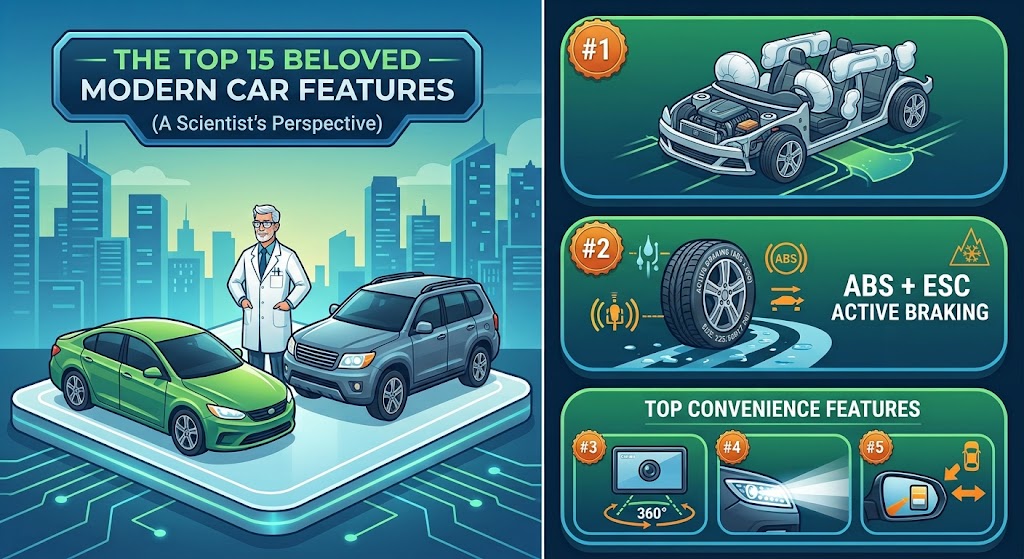
Active Braking & Stability Control (ABS + ESC)
Anti-lock Braking Systems (ABS) originally came from aviation, where stopping heavy aircraft on slick runways without blowing out tires was a matter of life and death. Yet, ABS alone was never explicitly mandated by U.S. law on its own—largely because early real-world safety studies showed surprisingly poor results. Drivers who grew up on old mechanical brakes kept manually tapping and pumping the pedal, interrupting the system, or panicked and let go of the brakes when they felt the system activate. This way of braking makes ABS useless.
It wasn't until federal law mandated Electronic Stability Control (ESC) in 2012—a system that relies directly on ABS hardware to control individual wheels—that ABS became effectively mandatory on all new cars. Together, ABS and ESC form the most powerful active safety foundation on the road: ABS prevents wheel lockup during emergency stops so you retain full steering authority, while ESC automatically taps individual brakes to catch a skid or spinout before you lose control entirely.
The operational rule for ABS is simple: stomp and steer. Do not pump the pedal or lift your foot. Press the brake pedal down as hard as you can and let the computer modulate hydraulic pressure up to dozens of times per second. If you feel a violent shuddering underfoot or hear a harsh grinding noise, don't panic—that sound is just the system working to give you full control in an emergency.
Modern Crash Protection & Airbag Systems
Sitting quietly at the very top of the list is a suite of technology that works silently behind the scenes, hoping you never have to witness it in action: structural crash architecture and multi-point airbag arrays.
Unlike convenience features or active electronic aids designed to prevent mistakes, passive crash protection is your final firewall when an unavoidable collision occurs. Modern vehicles are engineered as sophisticated energy-absorption shells. Crumple zones systematically collapse upon impact, dissipating massive kinetic forces away from the passenger compartment, while ultra-high-strength steel safety cages maintain structural integrity to protect occupants.
Surrounding that cage is a network of sensors that trigger front, side, curtain, and knee airbags in milliseconds. They form a cushioned barrier between human bodies and hard interior surfaces, drastically reducing severe head and chest injuries. It operates invisibly, requires zero maintenance or thought from the driver, and stands as the single most critical technological achievement in automotive history—quietly preserving lives so you never have to discover just how well it works.
Conclusion: Embracing the Good, Rejecting the Gimmicks
At the end of the day, I don't hate automotive technology—I understand it, respect it, and welcome it when it genuinely serves the driver and the environment. Take a look at our own driveway for a clear contrast in modern engineering trade-offs:
Our 2019 Audi Q7 is an offender of 7 features from my most-hated list, yet it also holds 11 of the beloved features listed above. On the other hand, our 2006 Volvo XC90 has exactly 1 hated feature and 1 loved feature (#2 ABS+ESC). To bridge the tech gap, I personally retrofitted an aftermarket head unit into the Volvo to add Apple CarPlay/Android Auto and backup camera, turning a reliable classic into a far more modern daily driver.
The core ethos is simple: if a piece of technology genuinely reduces driver fatigue, keeps us alive in a crash, cuts down emissions, or leaves the Earth a better place for future generations, then bring it on. But if a technology exists solely as a cash grab for automakers to squeeze subscription fees out of buyers or boost profit margins without providing real value to people or the planet, please keep it off our cars.