I absolutely love technology and am deeply committed to saving Mother Earth. I sincerely appreciate every effort by individuals and organizations to enhance safety, protect our environment, and make the world a better place. Car manufacturers are certainly part of that mission, but over the last two decades, many of their innovations have been entirely counterproductive. A surprising number of modern car features do nothing to benefit drivers or the planet—in fact, they cause severe harm to consumers, ruin long-term vehicle reliability, and generate unnecessary industrial waste, all to squeeze out a tiny fraction of an MPG so automakers can rack up lucrative EPA carbon credits that mean big money for their bottom line. Here are ten features that fit squarely into this category, ranked from merely frustrating to outright ridiculous.
Electronic Parking Brakes (EPB)
It all starts with replacing the bulletproof, mechanical handbrake lever with a flimsy electronic toggle switch. Beyond severing that satisfying physical connection to the vehicle, this design creates a genuine safety issue: if your battery dies, the brake locks up, leaving you completely unable to move or tow the car.
To make matters worse, it turns simple DIY maintenance into an unnecessary headache. Replacing your rear brake pads and rotors now requires a scan tool to retract the motorized calipers—or a sketchy workaround involving a 9-volt battery to hack the motor—a tedious step no one needed to deal with twenty years ago.
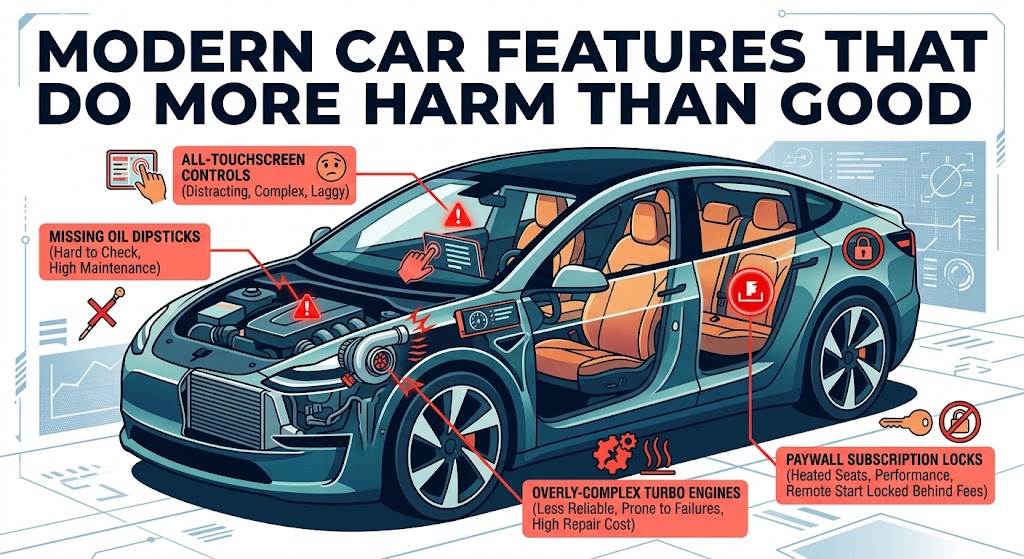
Removing Physical Engine Dipsticks
Automakers quietly phased out automatic transmission fluid (ATF) dipsticks decades ago, but in recent years, they’ve escalated to removing the engine oil dipstick entirely—a move heavily popularized by German manufacturers like BMW and Audi. Replacing a simple, zero-cost metal rod with electronic oil-level sensors buried inside infotainment sub-menus is a regression in every way.
You can no longer wipe a dipstick to visually check your oil's condition for fuel contamination or head-gasket leaks, and you are forced to wait for the engine to warm up before a glitchy sensor gives you a digital reading. If that sensor fails, it can trick you into overfilling your engine—blowing out seals—or leave you unknowingly running completely dry. An engine destroyed this way costs thousands of dollars to replace and creates an incredible amount of manufacturing waste and environmental pollution, making this a ridiculous and fast way to make the Earth a worse place.
Ditching the Spare Tire
Walk into a dealership today, and there is a high chance the trunk sub-floor contains nothing more than a cheap 12V air compressor and a can of sticky tire sealant. Automakers claim that ditching the 30-to-50-pound spare tire improves fuel economy, but for the individual consumer, that infinitesimal MPG bump amounts to mere pennies at the pump over a lifetime.
For car manufacturers, however, shedding those extra pounds across millions of vehicles boosts their fleet averages just enough to net massive regulatory payouts. The trade-off is a serious safety hazard for drivers: tire sealant gel is completely useless against a sidewall blowout or major puncture, leaving you stranded on the shoulder of a dangerous, high-speed highway waiting hours for a tow truck instead of spending ten minutes changing a tire.
Eliminating Physical Knobs & Buttons for Touchscreen Menus
Replacing tactile, muscle-memory HVAC knobs and volume dials with massive, glossy touchscreens is pure cost-cutting disguised as futuristic tech. Eliminating dedicated physical buttons forces you to take your eyes off the road and tap through sub-menus just to adjust the temperature, defog the windshield, or turn on a seat heater—a glaring driver distraction that actively compromises safety on every drive.
When these complex screens glitch, freeze, or suffer backlight failure out of warranty, you aren't just losing your stereo; you are locked out of basic climate controls, resulting in eye-watering repair bills for a full head-unit replacement that benefits no one except the dealer's service department.
Auto Start-Stop Systems
Everyone who has driven a modern car knows the maddening annoyance of the engine shutting off at a red light and shuddering back to life the instant you lift off the brake. What most people don't realize is that this feature exploded across the industry strictly because of EPA "off-cycle" credits created in 2012, which handed car makers easy compliance points. While regulatory policy eventually eliminated these credits in 2026, the damage has already been done.
Millions of vehicles are now on the road equipped with this system, leaving owners to pay the bill for premature starter motor and battery failures. Yes, automakers beefed up starters and starter gears for these cars, but no component engineered for a standard lifespan can withstand being restarted 10 to 15 times on a single commute without wearing down prematurely. This forces drivers to replace heavy-duty AGM batteries—which contain highly toxic lead—and fried starter motors twice as often. Generating extra industrial waste and dumping toxic heavy metals into landfills to save a thimbleful of gasoline at a stoplight isn't saving the planet; it's environmental theater at the driver's expense.
Ultra-Thin Engine Oils (0W-20, 0W-16, and 0W-8)
Some of you reading this may still remember pouring thick 20W-50 into your engine back in the day. Luckily, you didn't bet your life when you were younger that you would never see water-thin 0W-20, let alone 0W-8—yet 0W-8 is sitting right on the shelf at your local Walmart today. The classic argument against super-thin oil is well known: thin oil sacrifices critical film strength under heavy load and high temperatures, accelerating wear on cylinder walls and engine bearings.
Now, I won't argue with the manufacturers, and I respect the engineers. Yes, they did extensive testing, and yes, plenty of modern cars manage to rack up high mileage on these thin oils. But here is something nobody can deny: if ultra-thin oil is truly the holy grail of engine protection, why is the North American market practically the only place forced to use it?
Look at the latest Toyota Crown or Hybrid Camry models powered by the 2.5L engine. In the United States, the owner’s manual strictly demands 0W-8 or 0W-16, warning drivers to switch back as soon as possible if a thicker oil is used temporarily. Yet, flip open the manual for the exact same vehicle and identical engine block sold in international markets (like South America, the Middle East, or Southeast Asia), and Toyota explicitly approves 0W-20, 5W-20, and even 5W-30 or 10W-30 depending on operating temperatures. Why the discrepancy? It all comes back to EPA fleet fuel economy credits. Automakers force ultra-thin oils onto North American drivers strictly to scrape out a fraction of an MPG on regulatory test cycles. Running oil as thin as water leaves zero margin for error during hot summers (such as in the scorching desert of Arizona) or heavy towing, risking premature engine destruction and polluting the Earth with preventable scrap metal all for the sake of corporate regulatory points.
Direct Injection (DI) Without Port Injection
Direct Injection sprays fuel directly into the combustion chamber at ultra-high pressures. On paper, it’s a brilliant engineering feat that maximizes power output while squeezing out slightly better fuel efficiency. However, it abandons the greatest natural cleaning process in automotive history: traditional Port Fuel Injection (PFI). In traditional engines, fuel sprays over the back of the intake valves, constantly washing away oil vapor and carbon residue. With Direct Injection, fuel never touches those intake valves, allowing oil mist from the crankcase to bake into hard, black carbon deposits over time.
When carbon buildup gets severe, the engine chokes. The intake valves can no longer seal properly or let in clean airflow, resulting in rough idling, severe engine misfires, lost power, and terrible fuel economy. The fix isn't a simple $10 bottle of fuel additive poured into the gas tank—because that fuel will never touch the valves anyway. Instead, it requires removing the intake manifold and performing a labor-intensive "walnut blasting" service, where crushed walnut shells are blasted into the intake ports to scrape off the baked-on sludge. This labor-intensive maintenance costs anywhere from $600 to over $1,500 every 50,000 to 80,000 miles. When you do the math, any tiny fuel savings you gained at the pump over the lifetime of the car are completely wiped out by these mandatory, multi-hundred-dollar decarbonizing procedures—leaving the customer significantly worse off financially while generating unnecessary repair bills.
Turbochargers
Turbochargers aren't new technology—they've been around since World War II aviation and have graced performance cars for decades. They undoubtedly save fuel, and the rush of boost combined with the spooling sound is undeniably fantastic. But slapping a turbo onto everyday commuter cars to offset downsized engine blocks introduces extreme mechanical complexity. Turbos operate under unfathomable heat and spin at over 100,000 RPM, requiring intricate oil feed lines, dedicated coolant circuits, intercoolers, and complex vacuum plumbing to keep them alive. When a turbo eventually fails—or starves of oil from normal wear—the repair easily runs $3,000 to $5,000 or more.
To make matters worse, many modern turbocharged engines require premium 91 or 93 octane gasoline to prevent destructive engine knock under boost. With premium fuel typically costing 25% to 30% more per gallon than regular, that modest 10% gain in MPG quickly turns into a net financial loss at every fill-up. You spend significantly more money on gas every single week, only to sit on a mechanical ticking time bomb that will cost thousands when the forced-induction hardware inevitably gives out.
Over-Engineered / Integrated PCV Systems
The Positive Crankcase Ventilation (PCV) system exists for a simple reason: to vent harmful, high-pressure blow-by gases out of the engine's crankcase and safely route them back into the intake to be burned off. On older cars, the PCV valve was a simple, $5 piece of plastic threaded into the valve cover. It was completely reliable, easy to inspect, and took 30 seconds for anyone to replace in their driveway.
Then automakers decided to "improve" it by doing away with the cheap, standalone valve. Instead, they built non-serviceable PCV channels and delicate internal diaphragms directly into the engine's plastic valve cover or intake manifold. When these hidden systems fail, severe pressure builds up inside the crankcase. In freezing temperatures or under high load, the trapped pressure has nowhere to go and literally blows out the rear main crankshaft seal.
Look no further than GM's 2.4L Ecotec engines (found in millions of Chevy Equinox and GMC Terrain vehicles), which spawned massive class-action lawsuits after clogged PCV ports caused catastrophic oil leaks and complete engine failure. Toyota ran into similar oil-consumption nightmares with its 2.4L 2AZ-FE engine. It is extremely rare for a single engine to spark multiple separate class-action lawsuits—especially for a brand renowned for rock-solid reliability like Toyota. While Toyota officially denied any design defects, industry experts widely point to a perfect storm of failure points: a restrictive PCV system, low-tension piston rings, and back-spec'd ultra-thin oil (as discussed in #5). Together, these factors triggered rapid oil sludge, seized piston rings, and severe engine damage. Ultimately, both GM and Toyota had to issue special warranty extensions to quiet the outcry over their ruined engines.
Servicing these integrated PCV systems is well beyond the skill of an average car owner, routinely costing $500 to over $2,000 for a new valve cover assembly or rear main seal repair. Countless perfectly fixable engines have been completely toasted and dumped into auto recyclers simply because engineers over-complicated a 5-dollar plastic valve.
Below are two videos I created that can help protect your vehicle. The first demonstrates how to quickly check the health of the PCV system on virtually any car. The second explains how installing a specialized vented oil cap (FC219) can prevent catastrophic engine failure on GM Ecotec engines. Note: most parts lookups and auto retailers will claim the FC219 cap doesn't fit Ecotec models—it fits perfectly. It simply shows as incompatible because GM originally designed it for other engine lines. You can buy it through this link on Amazon for under $15.
Software Subscriptions for Built-in Hardware
Taking the absolute top spot for the worst modern car trend is paying a monthly subscription fee to unlock physical hardware that is already built into your vehicle. Unlike a failing part, this doesn't create a direct safety issue or break down under the hood, but it represents the most shameless, anti-consumer corporate cash-grab in automotive history.
When you buy a car, you pay for the heating elements inside the seats, the wiring harnesses in the floor, and the computer modules mounted behind the dash. Yet automakers have attempted—and in some cases, continue to attempt—to hold those physical components hostage behind software paywalls. Famous examples include BMW attempting to charge an $18-a-month subscription just to turn on heated seats, or companies charging recurring fees to access remote start or adaptive steering capabilities. It is completely unacceptable to the vast majority of consumers because it fundamentally redefines vehicle ownership. You no longer truly own the machine sitting in your garage; you are merely renting access to hardware you already paid.
Automakers claim these ten features represent progress, efficiency, and the future of mobility. But when you strip away the sleek marketing gloss and examine the real-world impact, the truth becomes obvious: they offer negligible benefits to the environment while burdening owners with distraction, massive repair bills, and degraded long-term reliability. True progress should empower drivers and protect the planet—not strip away ownership rights and force drivers to pay double for the privilege.