A flat tire is an inconvenience. A flat tire 60 miles from home on a rural highway is an ordeal. But what happened after I limped into a well-known national auto service chain proved even more frustrating than the initial puncture.
The experience swallowed most of an afternoon, completely upended how I think about tire-monitoring tech, and unexpectedly led me to an online source that saved me hundreds of dollars down the road.
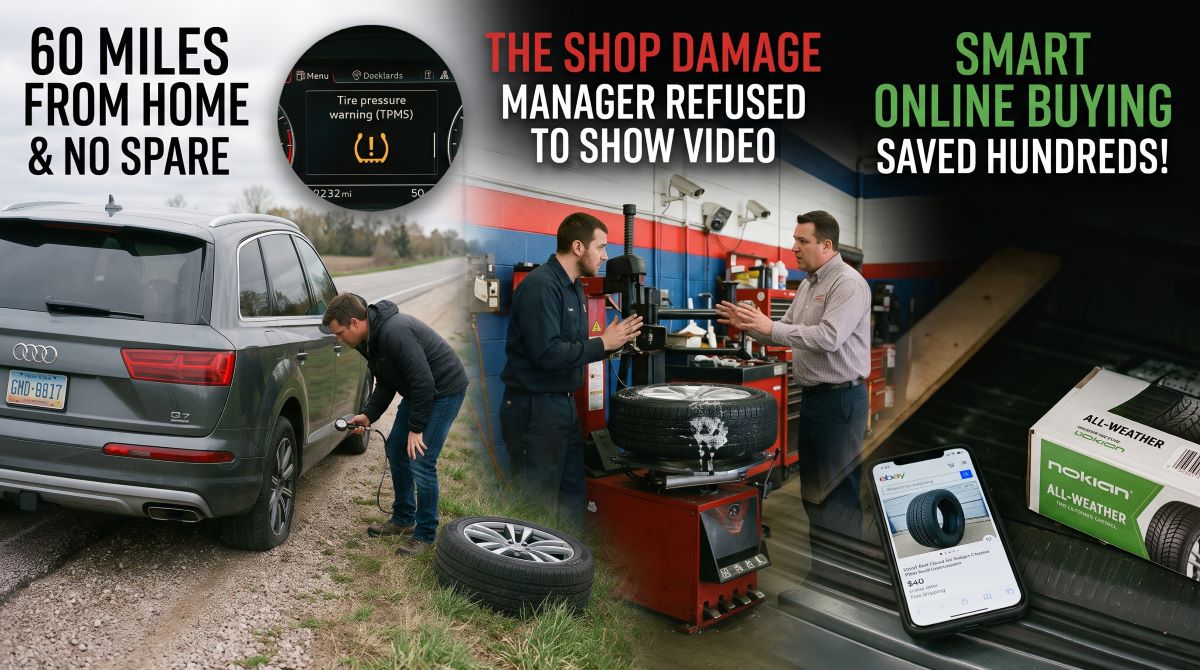
The Flat and the Missing Spare
I was cruising along the highway about an hour outside the city when the tire pressure monitoring system (TPMS) alert chimed.
The first major complication was the car itself. Audi does not equip the Q7 with a spare tire from the factory, giving you only an electric pump and a bottle of chemical goo. Knowing that limitation, I had actually gone out of my way to track down a genuine spare wheel and tire assembly for peace of mind.
With no spare on board, hunting down a shop was my only move. I pulled off the highway and started calling around. Every independent local shop had a long waiting list, and that national chain was the only place promising they could get me in and out within an hour. I drove straight over, hoping for a fast turnaround.
The "Repair"
The technician put the Q7 on the lift, inspected the wheel, and located a standard puncture near the center of the tread. Because it was squarely in the contact patch, it was a routine patch job. Relieved, we left the car with them and walked down the street to grab lunch.
When we returned an hour later, the car was parked outside. I paid the bill, jumped into the driver's seat, and drove away.
I didn't manually check the pressure with a gauge before pulling out of the parking lot, a mistake I still kick myself for. About a mile down the road, the TPMS chime went off again. I pulled into a nearby gas station, pumped air back into the tire, turned around, and drove straight back.
The Pinprick in the Sidewall
The technician put the tire back on the rack and coated it with soapy water to find the leak. Almost immediately, a steady stream of bubbles began foaming on the sidewall.
It was a tiny, needle-thin puncture, completely separate from the centered tread patch they had just installed. Because tire sidewalls constantly flex under load, damage there is fatal. The tire was ruined.
Then came the slip-up: right in front of me and his manager, the technician admitted that the sidewall hole hadn't been there when he first inspected the tire.
Tire bays are chaotic environments full of heavy pneumatic tools, sharp rim clamps, and stray debris. It takes only a careless drop against an exposed bolt or a slip with a tire lever on the mounting machine to puncture a sidewall.
The Video Stand-Off
When the manager insisted the shop wasn't responsible, I asked the obvious question: "How do you know it wasn't your fault?"
He immediately pushed back, claiming they had security camera footage proving their innocence.
"Great," I replied. "Let's go watch it."
He flatly refused, telling me they wouldn't pull or review the video unless I filed a formal lawsuit.
Knowing small-claims court over a single tire 60 miles away was a waste of time, I salvaged what I could: they refunded the patch fee and injected tire sealant into the puncture so I could limp home.
Sixty Miles of Blind Stress
That 60-mile drive home was an exercise in pure anxiety.
Every ten or fifteen minutes, the TPMS chime would ring out again, loud and insistent. Because the Q7 uses indirect TPMS, the car gave me zero data. I had no idea whether the tire was holding steady at 28 PSI, dropping toward single digits, or grinding on the rim.
The uncertainty forced me off the highway twice just to find an air pump, pull out a handheld gauge, and verify that the tire was still holding. Watching the road while waiting for the next warning beep, wondering if the temporary sealant would let go at 65 mph, was far more exhausting than getting the original flat.
The Replacement: The Full-Time AWD Dilemma
Once home, I faced a new mechanical headache. The Q7 features full-time quattro all-wheel drive, which demands that all four tires maintain nearly identical rolling circumferences to avoid overworking the center differential. My remaining three tires were sitting at around 7/32" to 8/32" of tread depth.
Throwing a brand-new tire onto that setup wasn't an option. I looked into Tire Rack, which offers a specialty tire-shaving service where they machine brand-new tread down to match your existing depth. But spending over $300 on a brand-new premium tire just to grind a third of its usable rubber straight into the trash felt both financially painful and environmentally wasteful.
I turned to eBay instead.
I filtered for high-volume commercial tire sellers and found an exact matching model listed at 7.5/32" of tread for just $40 with free shipping. It was a pressure-tested takeoff (tested three different ways, as claimed) from an established recycler with hundreds of thousands of reviews. I bought it immediately.
When the tire arrived, I put my depth gauge on it and found it was actually closer to 6/32" across the center ribs. I messaged the seller with photos of the gauge. Without arguing, customer support promptly issued a $12 partial refund. For roughly $28 net, I had a safe, matching tire that balanced easily and ran on the Q7 without issue for the next three years.
Key Takeaways
1. Automakers should be legally required to provide factory spares
Omitting a spare tire to shave weight and cut costs is one of the most anti-consumer trends in modern car design, which I included in my recently compiled list of the most hated new car features. If you buy a genuine spare wheel, strap it in for road trips. Having it sit on a shelf in your garage helps no one.
2. Direct TPMS is vastly superior to indirect systems
I honestly used to think indirect TPMS was the better design. With no wheel sensors, you avoid dead batteries, replacing expensive hardware, or buying extra sets for dedicated winter wheels. This incident completely cured me of that illusion. Generic warnings tell you nothing about the rate of pressure loss. Direct TPMS gives you actual live PSI numbers, letting you know instantly whether you have a slow seep or an imminent roadside emergency.
If your car also has indirect TPMS or no TPMS at all, you can easily add external sensors directly onto your tire valve stems. It gives you real-time pressure and temperature readouts right on your dash, and installing them is as simple as putting air in the tires. Check out my YouTube walk-through video showing how simple the setup is, and grab a compatible sensor kit on Amazon for about $20.
3. Always verify pressure before pulling out of a shop
Never assume a completed work order means the job was done correctly. Keep an accurate handheld tire gauge in your glovebox, check the cold PSI against the door-jamb sticker, and visually inspect the bead and sidewall before leaving the lot.
4. Vetted online tire sellers are worth exploring
Because of that good initial experience with the eBay tire seller, I later bought a brand-new set of Nokian All-Weather tires for my Volvo XC90 at 50% off retail from that exact same store, verifying fresh DOT date codes before ordering. When the Q7 finally needed a full replacement set later on, I rushed back hoping for another 50% discount. No luck that time, but it proved I was completely hooked on the hunt.
I had never even heard of Nokian before stumbling onto that deal. As it turns out, they are a legendary European manufacturer renowned for inventing the winter tire, and they remain the gold standard for cold-weather performance. Better yet: Nokian Tyres and Nokia (the iconic phone company) share the exact same roots. They originally started together under the Finnish Rubber Works conglomerate before spinning off into distinct businesses.
A single roadside mishap can turn into an expensive lesson in vehicle design and consumer rights. But once you know what to watch out for, and where to shop, you can turn an afternoon headache into long-term savings.