Chinese names are a source of constant fascination—and endless confusion—for Westerners. As a die-hard chess fan who spends way too many hours following tournaments, I can tell you that the comment sections during games with Chinese grandmasters are absolute battlegrounds of naming debates. Is Ding his first name or his last name? Why do people call Wei Yi by two short words? To put an end to the forum wars once and for all, I’ve put together this breakdown of how Chinese names actually work, so you can sound like a seasoned insider next time a major tournament rolls around.
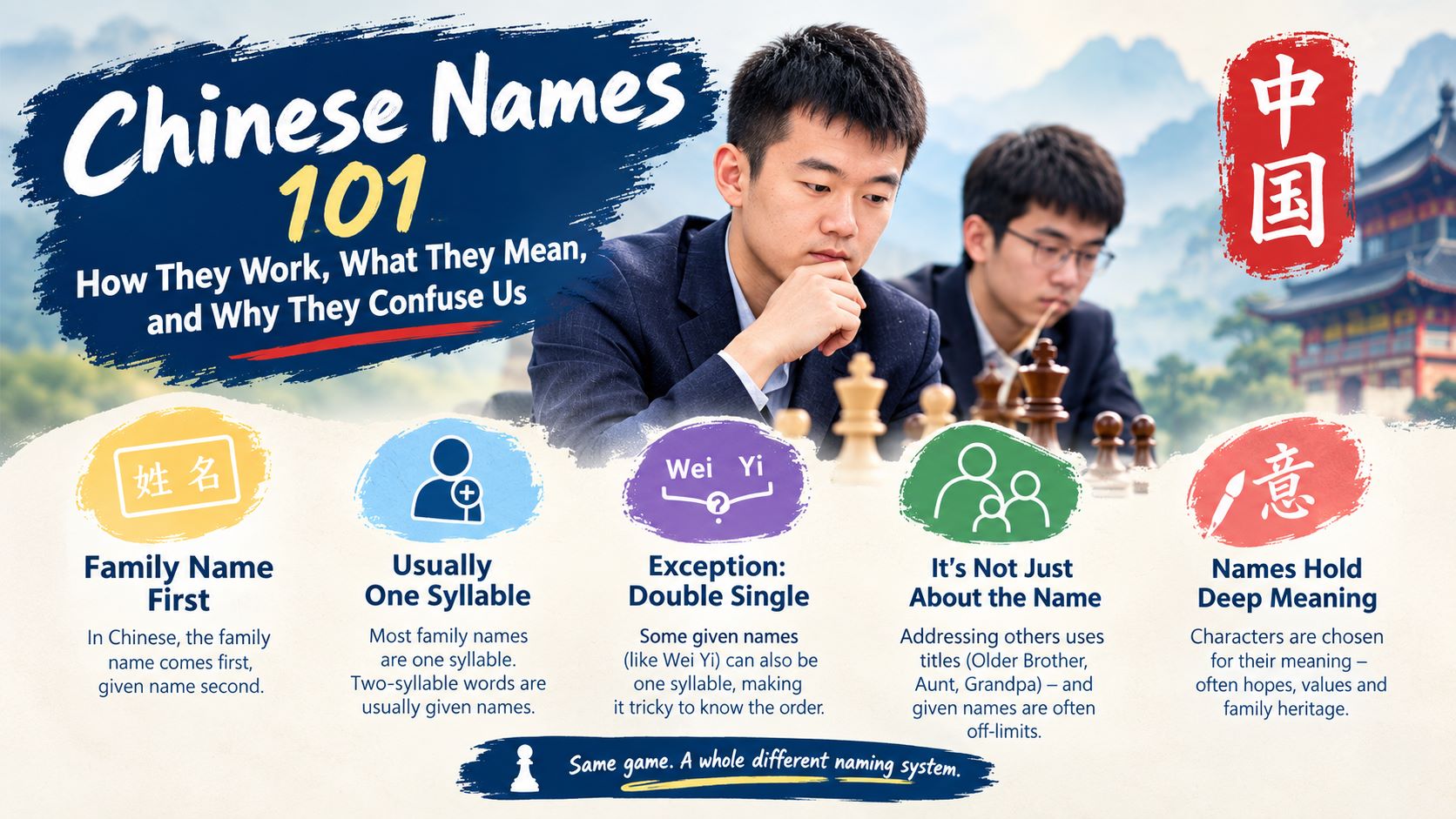
1. Name Order: Family First, Given Second
Let’s kick things off with the root of all the chaos: order. In Chinese, the rule is simple and unwavering—family name first, given name second. It’s even the official UN standard for romanizing Chinese names.
This native order is generally preserved when referring to global figures: sports icons like Yao Ming, chess grandmasters like World Champion Ding Liren or Wei Yi, and important political figures. In every single one of those traditional examples, the bolded first word is actually the surname.
Where the real head-scratching begins, however, is everyday life. When ethnic Chinese move to or live in the West, they routinely flip their names to match the Western format—placing their given name first—just to avoid bureaucratic headaches. The result? A confusing double standard where public figures stick to traditional ordering while your coworker David Li puts his surname last, leaving Westerners perpetually guessing which end of the name is which.
2. The Syllable Hack (And Its Major Exception)
Fortunately, there’s an easy hack to cut through the confusion. Almost every Chinese family name is monosyllabic—a single character, a single syllable. That means if a word in a name has two syllables, you are almost guaranteed to be looking at the given name. Armed with this trick, you can instantly spot classic media blunders—which happen daily, even with the biggest names in Western journalism! Calling World Champion Ding Liren "GM Liren" is the journalistic equivalent of calling someone "Mr. Christopher"—it mistakenly uses a given name as a formal title! While rare two-character surnames like Ouyang or Zhuge do exist, this single-syllable rule works over 99% of the time.
Of course, there is one major catch where this syllable hack completely breaks down: given names can also be monosyllabic. Grandmaster Wei Yi is the ultimate example. Both "Wei" and "Yi" are single syllables, and to make matters worse, both can serve as either a surname or a given name depending on the underlying Chinese character. When all you’re looking at is a Latinized spelling (or Pinyin, as the standard romanization system is called), it becomes practically impossible for a non-Chinese speaker to deduce which is which. In cases like these, unless you know the player beforehand or look up their name's native Chinese characters, even native speakers can occasionally hesitate on the order when it's rendered purely in English text!
Given how ridiculously hard it is to become a chess Grandmaster, you might assume that combining elite achievement with a double-single-syllable name is a statistical anomaly. It’s really not. Surnames and given names like Deng Yu or Wang Hong belong to this exact same head-scratching category. And if you think earning a grandmaster title is tough, winning the Fields Medal—the Nobel Prize of mathematics—is easily a hundred times harder. Yet, in a historic turn of events, mathematicians Deng Yu and Wang Hong both won the Fields Medal in 2026. So whether you are analyzing a brilliant 40-move chess tactic or reading about groundbreaking achievements in partial differential equations, the single-syllable puzzle is always waiting to trip up Western readers!
3. Addressing Others: The Taboo Around Given Names
When it comes to picking a given name, whether parents opt for a one-syllable or two-syllable choice in modern times is almost entirely down to personal preference. But this brings us to a mind-bending difference between Eastern and Western naming conventions. In Chinese culture, addressing someone solely by their given name can feel intimate, informal, or—especially if they are older than you—borderline offensive. Because of this deep cultural taboo around casually throwing around elder's names, there is strictly no such thing as "naming a baby after someone." You will never find a Chinese "John Smith Jr." or a baby named after her beloved Auntie Mei. Parents and children will never share a name. In fact, while sharing characters with peers of the same generation is common and often expected, parents actively ensure they avoid using any characters found in the given names of the elders of the baby!
Instead, people navigate social interactions using familial titles based on generation and age. Anyone older than you in your own generation is called "Older Brother" or "Older Sister." Someone in your parents' generation—whether by actual bloodline or simply by age—is addressed as "Uncle" or "Aunt." And anyone in your grandparents' generation becomes "Grandpa" or "Grandma." To make it personal, these titles are usually paired with a single character from that person's (family or given) name.
This brings us to a great formal introduction from the chess world: 17-year-old prodigy Kong Xiangrui, who earned his Grandmaster title and joined China's 2026 Olympiad squad. When young Kong Xiangrui addresses the senior World Champion Ding Liren, he doesn't use "Liren" or "Mr. Ding." He takes the Ren (人) from Liren's given name and calls him "Ren Ge" (人哥) in this YouTube video—literally, "Older Brother Ren." This subtle linguistic habit turns respect into a warm, familial bond.
4. Crafting Meanings: Custom-Built Identity
This taboo on given names means Western parents get off easy with a pre-approved menu of traditional names, while Chinese parents face the ultimate creative challenge: inventing a unique name from scratch—often spending sleepless days and nights obsessively flipping through classical dictionaries to craft the perfect combination of sound and meaning. In the West, names like Michael or Abigail are essentially just ancient labels—sure, an etymologist will tell you Michael originally translates to a Hebrew question ("Who is like God?") or Abigail meant "father's joy", but nobody naming a baby today thinks about those literal translations. They are just traditional names passed down through generations. In Chinese, however, the literal dictionary meaning of the chosen characters is the entire point.
Take World Champion Ding Liren (丁立人) again as a prime example. His family name is Ding. His given name, Liren (立人), is taken straight from a famous quote in the Analects of Confucius: "A person of virtue, wishing to establish himself, seeks also to establish others" (己欲立而立人). His name literally translates to "establishing oneself and helping others stand"—a profound moral aspiration baked right into his identity! Another beautiful illustration is figure skating champion Alysa Liu. While known globally as Alysa, her native Chinese name is Liu Meixian (刘美贤). Liu (刘) is her family name. Meixian (美贤) literally translates to "beautifully wise and virtuous"—a custom-built blessing passed down from her family.
5. Generational Name Poems & Ancestral Hierarchy
Now, let’s talk about a fascinating ancestral mechanism that takes naming conventions to an unbelievable level: the generational name poem (辈分诗, bèifèn shī). Historically, prominent Chinese clans composed poems where each character represented a specific generation in chronological order. For two-character given names, parents were obligated to lock in the generation's designated character as the first half of the child's given name, leaving only the second character open for personal choice. This acted as a living, genealogical blueprint—allowing two complete strangers from opposite sides of the world to look at each other's names and instantly figure out who is the "uncle" and who is the "nephew" in the clan hierarchy.
While generational name poems have largely faded for most modern Chinese family names, they remain strictly preserved in the family tree of Kong—the surname of Confucius—as well as the lineages of a few prominent pupils of Confucius (such as Yan, Zeng, and Meng). Returning to young grandmaster Kong Xiangrui (孔祥睿), sharp-eyed fans might notice that his surname, Kong (孔), is the exact same family name borne by Confucius (known in Chinese as Kong Fuzi / 孔夫子). But the connection runs far deeper than just sharing a last name. In the official imperial generational poems for the Confucius lineage, the character Xiang (祥) was explicitly reserved for the 75th generation. That single character in his name immediately tells anyone in the know that this teenage Grandmaster is officially a 75th-generation direct descendant of Confucius!
And here is where clan genealogy delivers an unbelievable real-life plot twist. Consider 50-year-old Kong Linghui (孔令辉), the legendary multi-time table tennis World and Olympic Champion. In his name, Ling (令) marks him as a 76th-generation descendant! We get an extraordinary situation: if 50-year-old sporting legend Kong Linghui were to meet 17-year-old chess grandmaster Kong Xiangrui, the 50-year-old table tennis icon would actually have to address the 17-year-old teenager as his ancestral uncle! Through a single character dictated centuries ago by an ancestral poem, thousands of years of lineage, sports royalty, and mind-bending family hierarchies instantly collide.
6. Pronunciation Realities
Finally, we arrive at the ultimate battleground among Western chess fans: pronunciation. The debates over how to pronounce names like Ding Liren in broadcast streams and online forums are seemingly endless. To native speakers, there is nothing mysterious or complicated here—these names simply follow the standard pronunciation rules of Chinese characters. However, even though the romanized Pinyin spelling uses the familiar English alphabet, the underlying phonetic rules are wildly different from English (if anything, Pinyin's vowel system actually shares more in common with German!).
Mastering the exact mechanics of Pinyin is complex enough to deserve its own dedicated deep-dive article. If you don't know the precise rules, default to your best natural English reading—nobody expects every casual fan to be fluent in Chinese phonetics. But if a native speaker corrects your pronunciation, take their word for it and don't become defensive: you are almost certainly wrong! And no, the way everyone in the west pronounces Ding Liren is very wrong (please see below).
Want to dig deeper into Chinese chess name pronunciations?