Most car owners—myself included, even as a lifelong DIYer—tend to live by a simple rule: if the engine is running fine without any obvious hiccups or check engine lights, why fix what isn't broken? Spark plugs easily slip into this trap. They are tucked away out of sight, and because modern engines are remarkably good at compensating for gradual wear, you rarely wake up to a car that suddenly won't start. It’s easy to look at a maintenance schedule, see a spark plug line item, and decide to push it off until the car actually gives you a reason to care.
The Audi Q7 2.0T Reality Check
Take my 2019 Audi Q7 2.0T, for example. It is now 7 years old with 70,000 miles on the clock. Audi’s official maintenance schedule calls for a super aggressive 40,000-mile spark plug replacement interval. As someone who knows double-platinum and iridium plugs are typically rated to easily last 100,000+ miles, I thought requiring a change at 40k was totally crazy. So, pushing nearly double that recommended interval, I finally pulled the trigger and replaced them.
The difference was immediate: the car became noticeably more responsive. For the past few months, I had started noticing what felt like classic turbo lag—a hesitating delay when stepping on the gas that was never there during the first six years of ownership. Once the new plugs went in, that lag completely vanished.
It turns out what felt like turbo lag wasn't an issue with the turbocharger at all, but aged spark plugs. As the plug electrodes wear down over time, the gap widens, requiring higher voltage to bridge the gap. Under heavy load—like when you step on the gas and boost builds—the higher cylinder pressure makes it even harder for a weak, worn plug to spark consistently. That slight delay or weak flame kernel causes soft combustion, creating a sluggish throttle response that mirrors boost lag.
Why Audi's Schedule Makes Sense: Asking a small 2.0L turbocharged engine to haul a heavy 4,500 lb SUV means those four cylinders are working under high boost and high heat far more often than a larger engine would. In fact, Audi sets the replacement interval for the bigger 3.0T V6 Q7 at 60,000 miles, precisely because the 2.0T works so much harder to move the same heavy chassis.
Replacing the four plugs on the 2.0T isn't terribly difficult. Sure, thanks to German engineering, it’s a bit more intricate than a standard 4-cylinder—there are wiring harnesses and tight clearances to navigate—but it is fully doable if you know how to turn a wrench. In fact, I did the job alongside my 14-year-old son; he actually handled most of the work himself! We documented the whole step-by-step procedure in a YouTube video, complete with links to all the exact tools and replacement parts in the description.
The $100 "Fun" Volvo XC90 V8
Then there is my 2006 Volvo XC90 V8, which I bought back in 2024 with 251,000 miles on the odometer purely as a fun side project. Very soon after picking it up, it developed a misfire. After swapping ignition coils around between cylinders, I confirmed that failing coils were the culprit. When I checked OEM parts, genuine Volvo replacement coils totaled an eye-watering $1,400 for the set of eight—a real belly-punching moment for a cheap project car. Instead, I took a gamble and picked up a full set of 8 coils on Amazon for $100. Two years later, those budget coils are still running strong.
At the time, I didn't even bother replacing the spark plugs of completely unknown age—a totally non-DIY mindset! I finally got around to replacing them recently, mostly because I hadn't touched a set of spark plugs in years and wanted to use the XC90 as a low-stakes rehearsal before tackling the more expensive Audi Q7. Despite being completely different engines, the warm-up paid off. And just like the Audi, the Volvo woke right up—it finally feels much more like a true V8 now.
Replacing the spark plugs on this V8 isn't very difficult either. Sure, space is tight toward the firewall, but you are already right there when replacing the coils anyway. If you want to see how the coil swap goes, check out my YouTube video showing the step-by-step procedure.
Reading the Plugs: What the Pictures Revealed
Taking a closer look at the old plugs pulled from both engines reveals a lot about how they were running:
The Audi Q7 Plugs
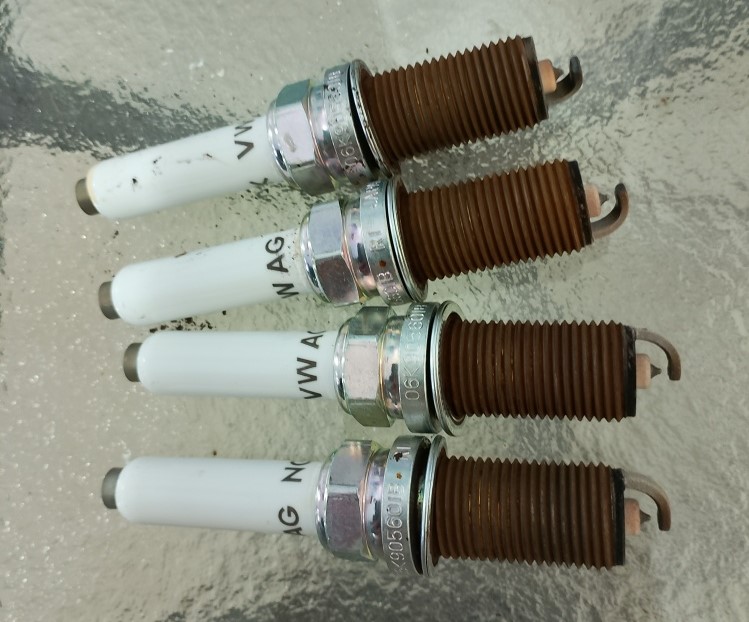
The four VW/Audi-branded plugs show uniform tan/brown coloring across all cylinders, which indicates optimal, healthy combustion. However, looking closely at the tips, you can see noticeable ground electrode erosion and a widened gap across the set. The threaded body also shows significant heat-related darkening, proving just how hot that 2.0T runs while hauling a full-size SUV.
The Volvo XC90 V8 Plugs
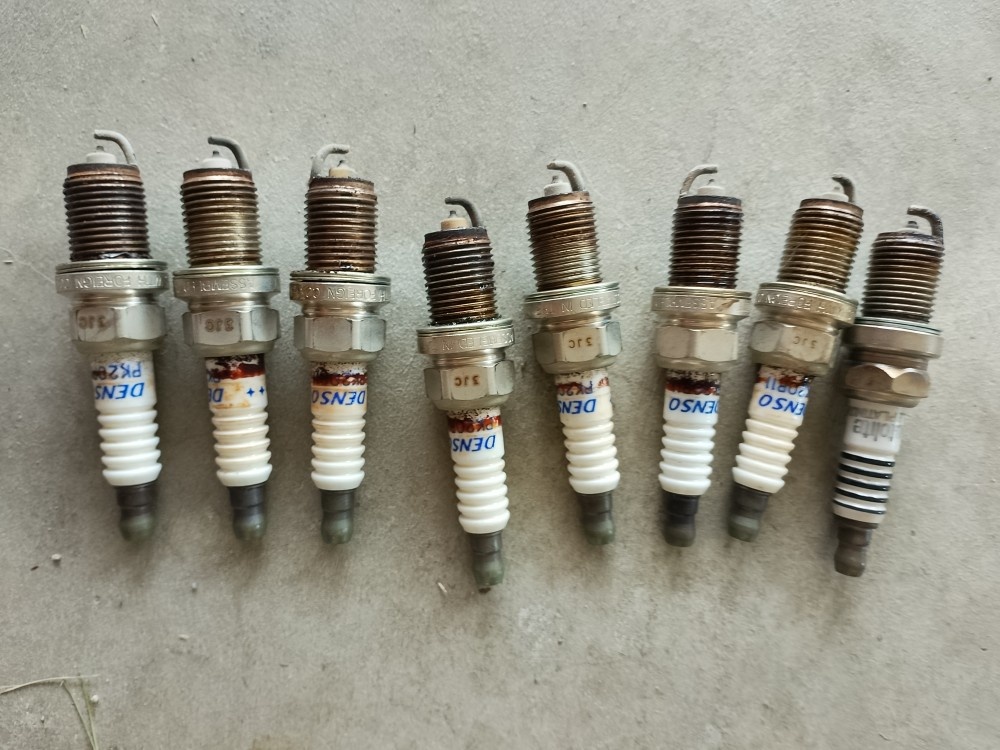
The eight plugs from the high-mileage Volvo tell a wilder story. Notice the wet oil residue coating the threads of several plugs. On a high-mileage car, this wet oil often stems from prolonged misfires caused by dead ignition coils, where unburnt fuel and oil residue pool around the threads instead of burning off cleanly. While it could also indicate a leaking valve cover seal, high-mileage plugs of unknown age should always be replaced alongside failing coils.
The "7 + 1" Shop Special
Look closely at the brand markings on the XC90 set—seven of the plugs are Denso PK20s, while the eighth is a completely different Autolite Platinum plug! What likely happened here is classic shop corner-cutting: during a routine spark plug service, the shop was probably low on stock or short one single Denso plug. Rather than waiting for the right part, they slapped in whatever random Autolite plug was sitting on the shop shelf to finish the job. It goes to show that just because a vehicle has service records doesn't always mean the shop was working with top-tier professionalism!
Final Thoughts
If your car has been feeling a little sluggish or you notice a subtle lag during acceleration, don't immediately blame the transmission or turbocharger. Aged spark plugs can sneak up on you over thousands of miles. Whether you drive a boosted 4-cylinder German SUV or a high-mileage Swedish V8, swapping in a fresh set of plugs is cheap insurance, a rewarding weekend project, and one of the easiest ways to bring back that new-car throttle response.