Nearly sixteen years ago, I was a brand-new homeowner who knew surprisingly little about maintaining a house. Major home systems intimidated me, and our natural gas furnace sat right at the top of that list. When our heating system began failing in the dead of winter—about three years after we moved in—it didn’t feel like a routine home repair. To make the stakes impossibly high, we had just brought home a newborn baby. With an infant in the crib, every cold draft felt urgent, and every mechanical malfunction felt dangerous.
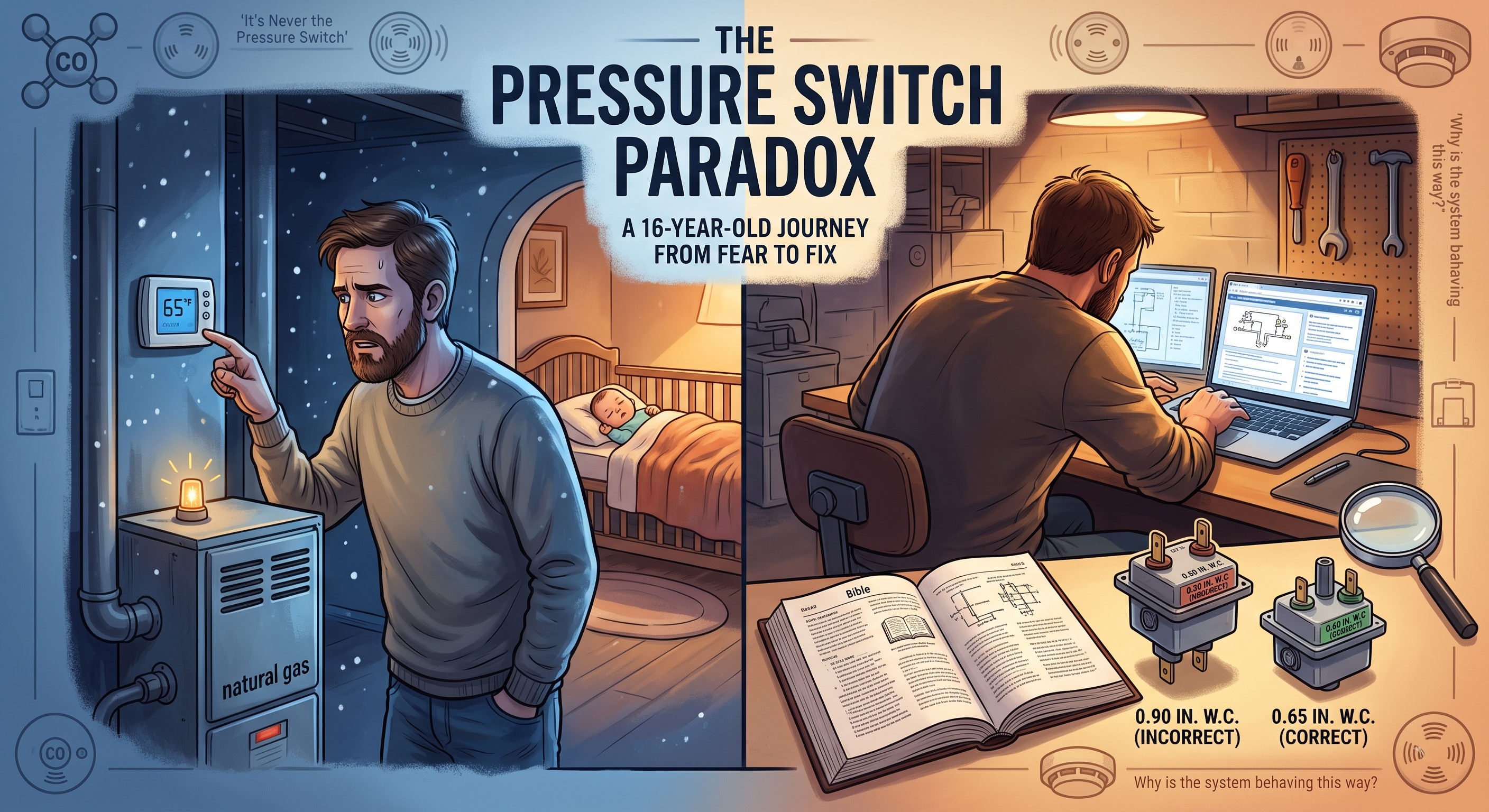
The Flashing Code
For the first three years after buying the house, the furnace ran without a hitch. But then winter hit, and the furnace began acting up. The thermostat was programmed to keep the house at a warm 72°F. Yet, on the coldest afternoons, I would walk through the front door, check the wall, and see a chilling 65°F. The furnace was short-cycling—firing up, running for a few minutes, and quitting long before reaching the set temperature.
Because it was a natural gas furnace, I couldn't just casually experiment with it. Incomplete gas combustion produces carbon monoxide—a silent, odorless killer. As a scientist, I understood the chemical risks completely. What I didn't understand was the machine sitting in my basement.
Fortunately, the previous homeowner had left the original manuals behind. On this specific model, you don't even need to remove the access panel to check for diagnostic errors. I simply looked straight through the small glass sight window at the bottom panel, where an LED inside was flashing a distinct pattern: six blinks.
Six Flashes: Pressure switch opened during a call for heat.
"It’s Never the Pressure Switch"
A quick search taught me that the pressure switch is a vital safety guardian. Before the furnace ignites, an inducer motor turns on to pull fresh air into the burners and vent toxic exhaust outside. The pressure switch measures this draft airflow. If the pressure isn't right, the switch stays open, cutting power to the gas valve to prevent dangerous combustion.
However, every HVAC forum online screamed the exact same warning: "Pressure switches rarely fail. It is almost never the switch itself."
Techs explained that an open switch usually meant a blocked flue pipe, a dying motor, or a clogged drain line. The switch was simply doing its job by shutting the system down. But my vent pipe was crystal clear, and the motor was spinning freely.
Confused, I removed the physical switch to read the label stamped on its housing. Then, I cross-referenced it with my model in the factory manual.
My heart sank. The numbers didn't match.
The Mismatch
The parts list was indisputable:
- Installed Switch: Rated for 0.90 inches of water column (in. W.C.).
- Manual Specification: Rated for 0.65 in. W.C.
My furnace was a 5-burner model. The installed 0.90 in. W.C. switch actually belonged to a bigger trim of the exact same product line—the 6-burner model.
Because my smaller 5-burner motor was only engineered to pull around 0.70 to 0.80 in. W.C. of pressure—and on good days, slightly higher than 0.90 in. W.C.—the installed switch was sitting right on the razor's edge of failure. During the furnace's first few years, a strong, brand-new motor managed to clear that high threshold, which is why it ran fine for our first three years in the house. But as time went on, on exceptionally cold days, minor atmospheric changes or subtle drops in pressure caused the draft to dip below 0.90 in. W.C., tripping the safety switch and killing the heat.
I was staring at a mystery that directly impacted my family's safety.
The Science of the Danger
I found myself trapped in an agonizing paradox:
If I trusted the manual and installed the lower-rated 0.65 in. W.C. switch, it would require less draft pressure to close. But what if the manual was wrong? What if I was making a catastrophic mistake, and the lower threshold allowed the furnace to run during a real airflow restriction, filling my baby's nursery with deadly carbon monoxide?
I spent days obsessed. I cross-referenced part numbers, verified furnace schematics, searched trade forums, and checked supplier databases. Everything was consistent with the manual.
But that doesn't help much. The factory manual is the Bible. Everywhere else copies the Bible. Of course the parts stores and forum posts agreed with the specification—they were all sourcing their data from the exact same documentation. I hadn't independently proven the manual was infallible; I had just failed to find anyone contradicting it.
Running out of choices, I built a safety net. Before touching a single tool, I bought four brand-new carbon monoxide detectors—mixing different brands and models—and mounted them in the basement and living quarters. If my math or the manual failed, the alarms would not.
BTW, hope you never encounter my problem but for the safety of your family, you should still consider installing a few carbon monoxide detectors inside your house. Read my other post to know why.
The 5-Minute Fix
After days of agonizing research, the physical repair took less than five minutes:
- Power Off: Flipped the emergency electrical shutoff on the cabinet.
- Disconnect: Unclipped the two spade wire connectors and pulled the rubber vacuum hose off the barb.
- Swap: Unbolted the two mounting screws, removed the incorrect 0.90 in. W.C. switch, and secured the genuine 0.65 in. W.C. factory part.
- Reassemble: Reattached the hose, snapped the wires back on, and restored power.
I turned up the thermostat. The draft motor hummed, the new switch clicked shut, the burners ignited, and roaring heat restored the house to a steady 72°F. It never short-cycled again, for a whole 13 years.
How Did It Get There?
I will never know for sure who put the wrong part into the furnace, but looking back, I see three distinct possibilities:
1. Technician Error
Very UnlikelyThe furnace was only six years old when I bought the house. Because pressure switches almost never fail, there was virtually no reason for a tech to have replaced this part so early in its lifespan.
2. Accidental Swap
LikelyOn a fast-moving assembly line, someone could easily reach into the wrong bin, grab the switch intended for the 6-burner trim, and bolt it onto my 5-burner unit. Mistakes happen.
3. Line Substitution
Likely (Alarming)An assembly line manager ordered to ship 100 units runs out of 0.65 switches. They grab 100 higher-rated 0.90 switches knowing it fails safe and will run during the first few years while the motor is strong. Breakdown down the line becomes someone else's headache.
A Lesson 13 Years in the Making
Recently, I retold this story to my son—the very same baby who was sleeping upstairs in his crib during that freezing week thirteen years ago. He is a teenager now.
When I reached the moment I realized the installed part contradicted the factory manual, I paused and asked him, "What do you think I should have done?"
Without missing a beat, he replied, "Called a professional."
I laughed. "Sure but that's not very comforting. After all, some professional put an incorrect part into it"
Knowing how to turn a screwdriver is easy. The hard part of any repair is having the courage to stop, question what you are seeing, verify the evidence, and ask: "Why is the system behaving this way in the first place?"