If you are a football fan, for the last 30 years, the most iconic name in the sport has undoubtedly been Ronaldo. From Milan to Madrid, from Barcelona to Manchester, the name has defined multiple generations of greatness.
Yet despite their wildly different styles and personalities, the three most famous Ronaldos in football history share one remarkable connection: Portuguese is their native language.
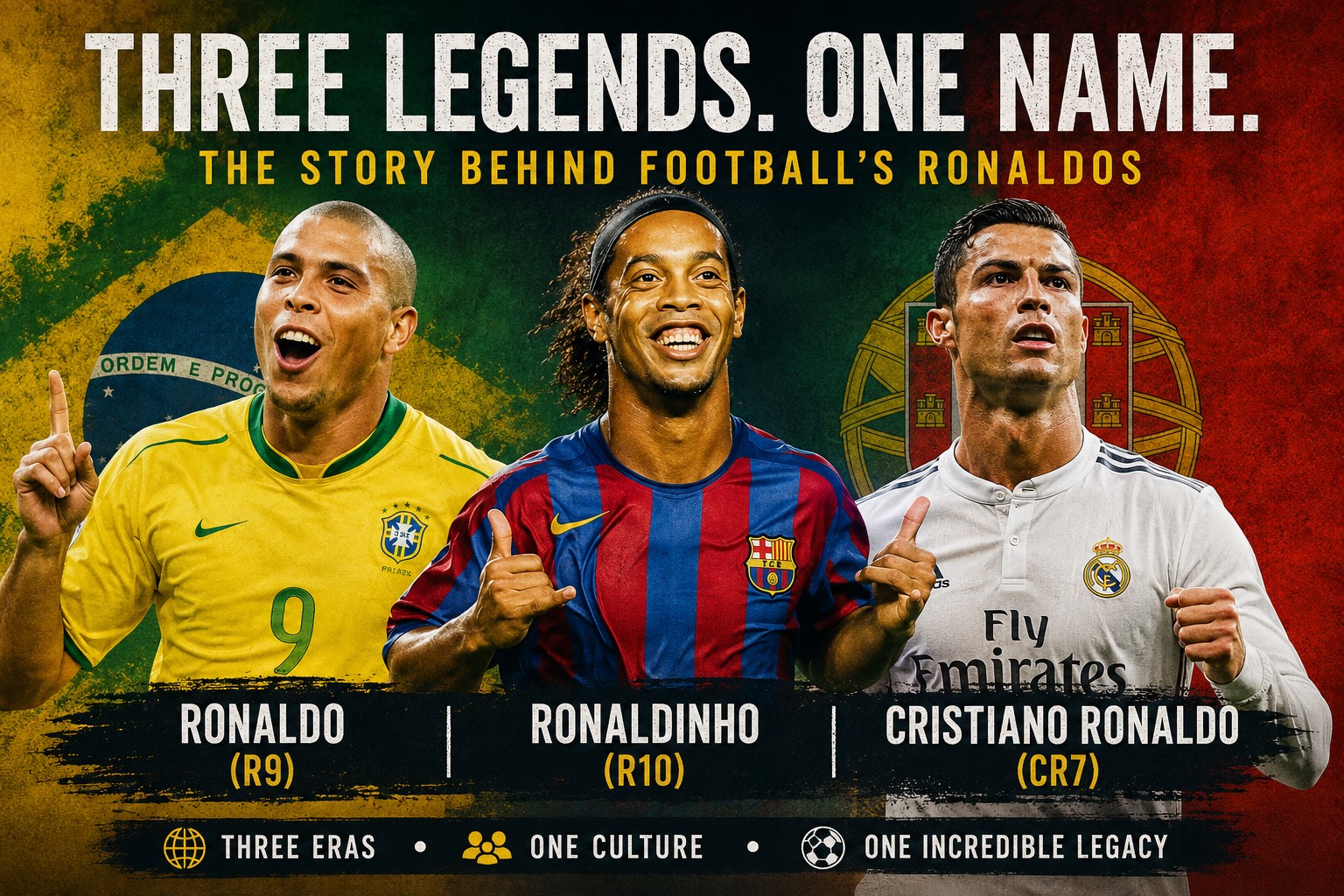
⚡ The Phenomenon: R9
The story begins with Ronaldo Luís Nazário de Lima — known to millions simply as R9.
For many fans, he remains the definitive Ronaldo: a striker who combined explosive acceleration, impossible dribbling, and clinical finishing in a way football had never seen before.
At his peak, he looked almost supernatural. Defenders could not keep up with him, goalkeepers feared him, and entire tactical systems were built around stopping him.
Ironically, however, the man born “Ronaldo” was once unable to fully use that name on the international stage — a twist that would later shape football history itself.
🎩 The Artist: R10
Then came the magician: Ronaldinho.
What many casual fans do not realize is that his legal name is actually Ronaldo de Assis Moreira.
The nickname Ronaldinho literally means “Little Ronaldo.” While he was called that as a child because he was often the smallest player on the pitch, the name later became a deliberate professional choice.
By the time he entered the Brazilian national team, R9 was already a global superstar. Ronaldinho understood that trying to compete under the exact same name would leave him permanently in another man’s shadow.
Instead, he embraced the nickname and transformed it into one of the most recognizable brands in football history.
The decision worked so well that many fans today do not even realize that both men were originally named Ronaldo.
👑 The Icon: CR7
Finally came Cristiano Ronaldo dos Santos Aveiro.
Many fans assume that “Ronaldo” is his surname, but that is actually incorrect.
In Portuguese naming traditions, people commonly have multiple given names followed by multiple family names. In Cristiano’s case:
- Cristiano Ronaldo → his given names
- dos Santos Aveiro → his family names
The origin of the name is even more surprising. His father admired Ronald Reagan, the American actor and former US president, and chose “Ronaldo” as a tribute.
When Cristiano became a professional footballer, he chose to use his second given name on his shirt rather than his family surname — effectively turning a childhood tribute into one of the most famous sporting identities on Earth.
🇵🇹 The Portuguese Naming Tradition
To fully understand why these legends are known as Ronaldo, you also need to understand Lusophone (Portuguese-speaking) football culture.
In countries like Portugal and Brazil, players often use:
- their first name,
- a shortened variation,
- or even a nickname
in official football settings — including on jerseys.
That is why fans see names like Ronaldinho, Kaká, Pelé, or Cristiano Ronaldo instead of formal family surnames such as Moreira or Aveiro.
🤯 The Ultimate “Aha” Moment
The way these three legends inherited the “Ronaldo” identity almost feels like a perfect generational handoff.
But there is a forgotten piece of football trivia that makes the story even more fascinating.
During the 1994 World Cup and the 1996 Olympics, the original R9 actually wore the name:
Why?
Because there was already an older Brazilian defender named Ronaldo on the squad.
To avoid confusion:
- the veteran became Ronaldão (“Big Ronaldo”)
- and the teenage superstar became Ronaldinho (“Little Ronaldo”)
Only after dominating European football did R9 reclaim the plain “Ronaldo” identity.
In doing so, he unintentionally vacated the nickname just in time for the next Brazilian genius to inherit it — creating one of the most poetic naming successions in sports history.