Fifteen years ago, I bought my first home. Like most buyers, I relied on the professional home inspection, which included a radon test. It was summer, and the results came back at 2 pCi/L—well under the EPA action limit. I was told the house was safe, and for most people, that would have been the end of the story.
But I have always been someone who likes to ponder how things work. My unlimited curiosity about the systems in my home likely saved my family health.
The Earth's Natural Decay
Radon is a radioactive gas produced naturally from the earth soil as uranium and radium decay. In the open air, radon concentrations remain very low and relatively harmless because the gas disperses. However, when a house is built over this soil, the foundation acts as a trap. Inside the confined space of a home, radon can reach high concentrations, transforming from a natural byproduct into a silent killer—the leading cause of lung cancer among non-smokers.
The Winter Revelation: Frozen Soil and the Stack Effect
I didn't suspect anything. I knew rather little about house back then. But when the first winter hit, I bought a digital radon monitor just to satisfy my own curiosity. I was shocked when the numbers jumped to 6 pCi/L. I soon learned why winter is the most dangerous season for radon:
- The Frozen Cap: In winter, the ground outside freezes solid, acting like a lid. The radon gas trapped in the soil cannot escape through your yard, so it migrates to the only warm, unfrozen exit it can find: the soil directly beneath your heated basement.
- The Stack Effect: As you heat your home, warm air rises and escapes through the upper floors. This creates a vacuum in the basement that literally sucks the concentrated gas out of the ground.
The Fix: From Curiosity to Urgent Action
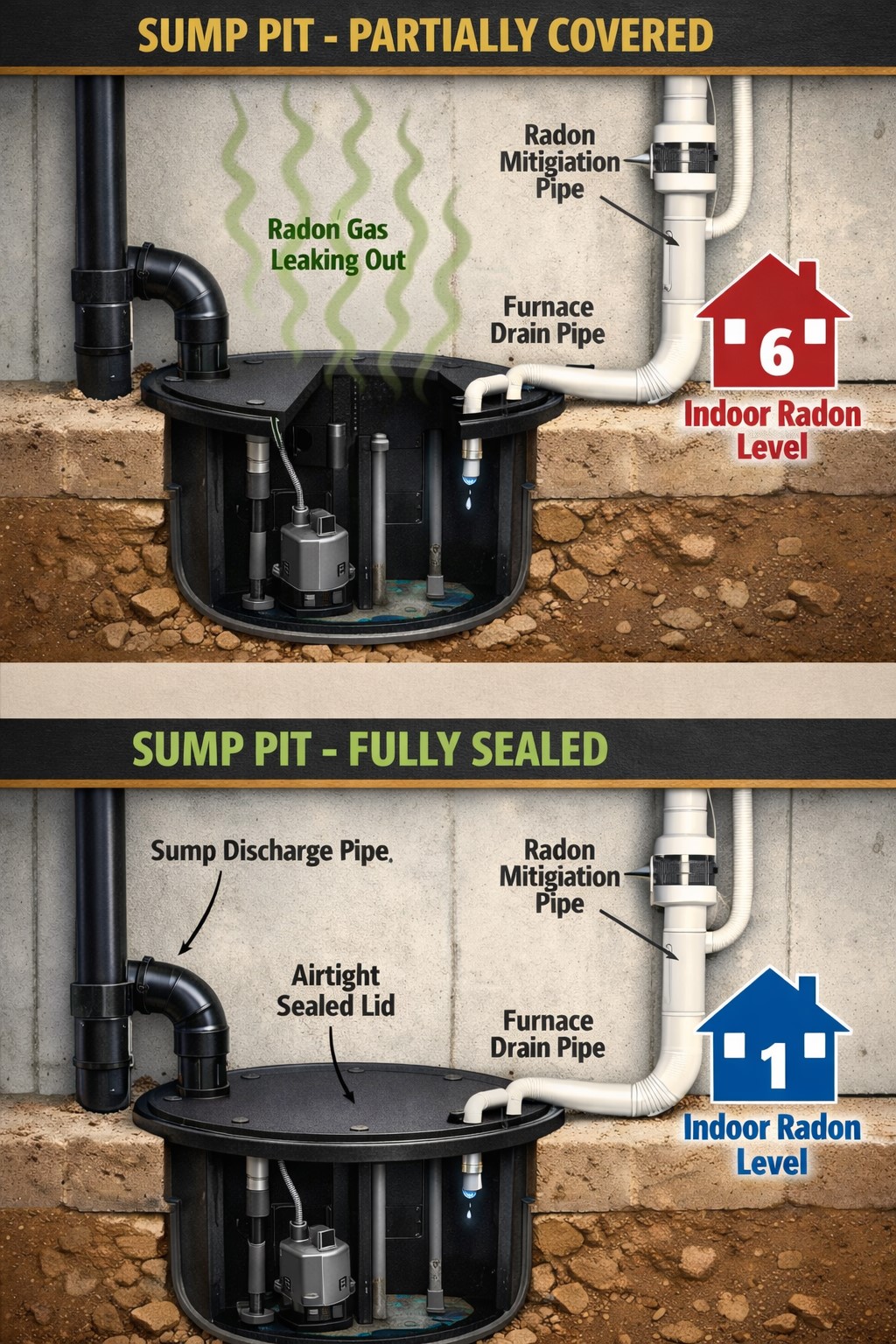
Seeing a 6 on the screen changed everything. This was not just a hobby anymore; it was an urgent mission to protect my family. I investigated the basement and found something both hilarious and concerning: the home had a radon mitigation system installed on the sump pit, but the sump pit was only two-thirds covered.
The system was trying to vacuum the basement air instead of the soil gases, while the open pit acted like a chimney for radon. I sealed the pit myself, ensuring the radon pipe, sump discharge, and furnace drain were all airtight. Immediately, the levels plummeted and reached 1 pCi/L a week later, where they have stayed for 15 years.
The Life-Saving Proof: Pro-Machine Validation
The original monitor proved its worth one more time when a friend borrowed it and discovered his levels were a staggering 15+ pCi/L. He immediately brought in a professional mitigation team. The most convincing part? We compared our consumer monitors against the contractor high-end, calibrated professional machine both before and after the installation. At both the dangerous 15+ level and the safe post-mitigation level, the numbers were nearly identical. This validated that these devices provide professional-grade accuracy. He felt the device literally saved his life, and he bought me a brand-new model from the same company in gratitude.
The Two Best Tools for the Job
| Safety Siren Pro4 | Airthings Corentium |
| Made In USA | Made In Norway |
| Plug-in (Continuous) | 3 AAA Batteries |
| Pro-Machine Validated | Pro-Machine Validated |
| Digital Display + Alarm | LCD Screen Only |
| 15+ Years Service Life | Professional Favorite |
1. The Reliable Workhorse: Safety Siren Pro4
This is the updated version of the Pro3 I bought 15 years ago (which is still running today). It is a continuous monitor with an audible alarm that triggers if levels hit 4.0 pCi/L. It is perfect for a permanent setup where you want a clear, glowing display as a constant watchdog.
2. The Portable Pro: Airthings Corentium Home (Model 223)
This is the model my friend chose. It is battery-operated and completely portable, making it the perfect choice if you want to test multiple rooms, different floors, or take it to a family member house to check their safety.
This could happen to anyone. You may have a perfectly sealed sump pit, but hidden cracks can develop in a basement floor over time, allowing gas to seep in. Many homeowners mistake the manometer on the radon mitigation pipe as a safety gauge. In reality, that gauge only confirms the fan is creating a vacuum; it says nothing about the concentration of radon entering your living space. For the safety of your entire family, you should get a monitor and check your levels. They are an investment (roughly $120-150, depending on current pricing) but are totally worth the peace of mind. The purchase links are included in the two paragraphs above.