To a Western Chess player, Chinese Chess (Xiangqi) rules feel like a fever dream: perpetual checking is illegal, the leader is trapped in a box, and pieces jump over each other to capture. Conversely, a Xiangqi player looks at Western Chess and finds it absurd that a trapped King can swindle a draw through stalemate or that a tiny Pawn can magically transform into a powerful Queen. Even though these rules seem odd to outsiders, they were designed to make the games more fun and playable. As games, they are equally beautiful. I personally enjoy both games immensely. To fully appreciate the beauty of the games, it's important to understand the reasons behind the rules. If you look deeper, you realize that the oddities of Xiangqi almost always have a grounded historical context and—sorry chess players—chess is the odd one in reality.
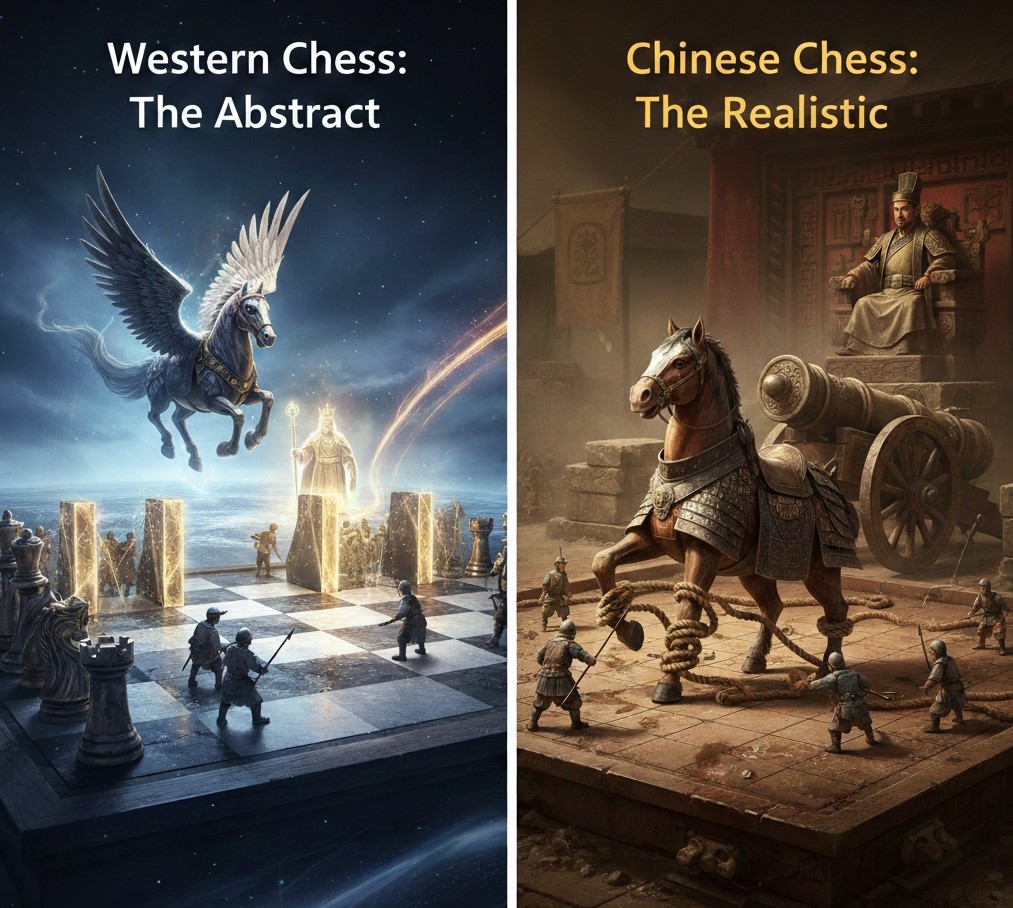
In ancient China, the Emperor was a sacred figure. Suggesting that an Emperor could be trapped or defeated on a game board was often a kiss of death for the creator. To stay safe, players called the piece a General. Yet, the General still reflects the lifestyle of an Emperor: he is confined to the Palace and almost never steps foot outside its walls. This confinement is the heart of the game’s tension.
One of the most jarring rules for a Chess player is that the two Generals can never face each other on the same open file. Whichever general is forced to face the other on an open file loses the game immediately. Historically, this makes sense—Emperors almost never met in person on the battlefield; such a meeting would result in immediate, decisive conflict. Mechanically, this makes the game much more decisive. Without this rule, a lone Horse or a Cannon with a single Advisor (his defensive assistant) cannot force a win. The Flying General rule turns the leader into a long-range weapon that helps his own pieces deliver the final blow.
In Western Chess, the King is a bit of a superhero. He has been called a baby queen because of how strong he becomes in the endgame (after queens have been removed from the board). He can move in eight directions and charge across the battlefield to hunt down pawns, or even rooks.
In contrast, the Xiangqi General is a prisoner of his status. Moving only in four directions, he is a liability. Because he cannot move diagonally, he is incredibly easy to corner. He cannot slip past an attacker; he can only shuffle within his tiny 3x3 box.
This weakness is exactly why the rule against perpetual checking is so necessary, even if it feels illegal to Chess players. Imagine a single Rook attacking a General who is not in the center of the Palace. Since the General cannot move diagonally to escape the line of fire, the Rook could simply move back and forth, checking him on every single turn. He would be forced to pace between two squares forever. The rule forces the attacker to break the cycle because the General is simply too weak to save himself.
The Western Knight is a magical teleporter that ignores physical obstacles. In contrast, the Xiangqi Horse follows the laws of physics. In ancient Chinese warfare, a common strategy involved using ropes or hooked spears to hit the feet of horses to stop a cavalry charge. The game reflects this perfectly: if a piece stands on the intersection directly in front of the Horse, that horse is hobbled and cannot move in that direction. You can't capture the horse this way; you are physically blocking his path and his effectiveness.
The Cannon is a masterpiece of realism. In real-world warfare, artillery requires specific positioning to be effective. The rule that he needs exactly one piece—the screen—to jump over is a brilliant representation of this. Crucially, the screen can be your own piece or even an enemy piece. Sometimes in real war, you must take advantage of the enemy’s own setup to strike them. It turns the board into a game of logistics where your own pieces are just as important for where they stand as for what they can kill.
In chess, you typically push the central pawns (the D or E pawns) to control the center as your first move. If you do that in Xiangqi as your first move, it's almost in a resignation territory. Instead, a Cannon is used to threaten the opponent's center while a Horse is utilized to protect one's own center.
Stalemate is totally at odds with the Xiangqi philosophy of total conquest, or with real wars. But in Western Chess, it prevents the game from becoming a trivial math exercise. Consider a King and a Pawn vs. a lone King. Under current rules, the winning side must be mathematically precise. If you removed stalemate and made it a win, the player with the extra pawn would win every time regardless of skill.
Furthermore, consider the difficult Bishop and Knight checkmate—it is a notoriously complex endgame that even some Grandmasters, like Anna Ushenina in 2013, have failed to convert under time pressure. Without the threat of stalemate, this win would be effortless. You could simply drive the King into a corner without any fear of accidentally ending the game in a draw. Stalemate keeps the winning side honest and precise until the very last move.
In Western Chess, an overachieving Pawn can magically become a Queen. In real life, a soldier’s best chance is becoming a junior officer, not the ruler of the kingdom. She undergoes a supernatural transformation that completely changes the game’s power balance. Xiangqi goes the opposite direction. When a Soldier reaches the last rank, he doesn’t promote; he actually becomes weaker. He can no longer move forward, only sideways. He is like a veteran who has reached the enemy back wall and has nowhere left to march. In this case, both chesses are disconnected from reality.
Whether it is the swindle of a stalemate in Western Chess or the tactical ropes tripping a horse in Xiangqi, these games use their oddities to create deep strategy. I enjoy the dance between both battlefields, and I find that understanding the why behind the rules makes the moves all the more satisfying.