I decided to write this guide for two reasons. First, the level of misunderstanding regarding electrical safety is massive. This isn’t necessarily your fault; the word grounding itself is a historical misnomer. Most people misunderstand it, and surprisingly, many licensed electricians do too. Second, grounding is vital—do it right, and it saves lives; get it wrong, and it can kill.
Understanding its true purpose only requires middle school physics. The hard part is letting go of your preconceptions. Clear your mind, and let’s look at the facts.
The Residential Wiring Layout
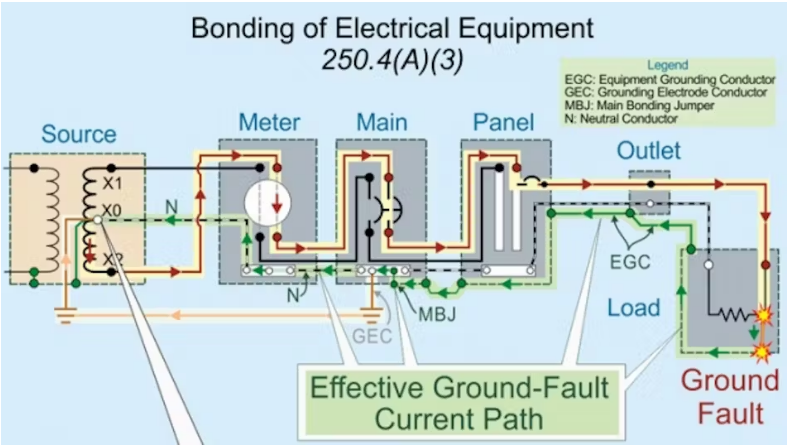
The diagram above shows a typical North American residential setup. The ‘Main’ in the diagram is the main panel, while the ‘panel’ is typically referred to as the sub-panel. If your home doesn't have a sub-panel, simply imagine the lines within connecting directly. Here is the breakdown of what you see:
- EGC (Equipment Grounding Conductor): The green line connected to the round pin of a three-prong outlet.
- N (Neutral): The dashed black line.
- Red and Black Lines: The hot (live) wires.
You will notice there is only one GEC (Grounding Electrode Conductor) per meter—that long metal rod driven into the earth. While connecting to water pipes was allowed in the past, it is generally no longer permitted. There is also a ground at the transformer (source).
Beyond these points, there is no reason to ground anything else to the physical earth. Do not connect an appliance's metal casing to a nail in the wall or the floor and call it grounding. This is a completely incorrect and extremely dangerous practice. Below, I will explain why.
The Big Secret: The Main Bonding Jumper (MBJ)
Look closely at the diagram above. There is a component called the MBJ (Main Bonding Jumper). It literally connects the ground wire and the neutral wire together. Yes, you read that correctly. This is a requirement of the official NEC (National Electrical Code).
This process is called Bonding. Because of this connection, if you take a multimeter to any outlet and test the resistance between Neutral and Ground, it will be zero. This is exactly how it is supposed to be.
If They are Tied Together, What is the Difference?
In a normal scenario, electricity only flows through the neutral wire back to the source. The ground wire carries zero current. However, if a hot wire comes loose and touches the metal casing of an appliance, the ground wire provides a path back to the MBJ and then to the neutral.
Because this metallic circuit has extremely low resistance, it creates an instantaneous overcurrent that trips the circuit breaker. The goal of a ground wire is to trip the breaker before a human touches the energized casing.
This is why many appliances with metal shells must be grounded. However, if an appliance is double-insulated (often marked with a square-within-a-square symbol), it is designed so that even if a wire fails, it cannot touch the outer casing. In those specific cases, a ground wire is not required, which is why some metal-housed devices only have a two-prong plug.
The Reality of the 25-Ohm Rule
You might hear people talk about specific resistance numbers for ground rods. The NEC says that if you are bored enough to actually measure the resistance of your ground rod and it is over 25 ohms, you must add a second rod. However, the NEC does not actually require you to perform this measurement.
Most residential installations simply involve driving two rods to be safe and moving on. The code implicitly acknowledges that the rod isn't meant to carry fault current. If you have two rods and the resistance is still high, the code essentially suggests you stop there—it recognizes that trying to fight the natural resistance of the soil is a losing battle.
Why the Earth Cannot Save You
Soil resistance is incredibly unreliable. A ground rod might measure 20 ohms today and 1000 ohms in a few months during a dry season. In arid regions, high resistance is the norm. Consider the physics of Ohm's Law:
$$I = \frac{V}{R}$$
Even at 20 ohms on a 120V circuit, the earth only draws 6 amps. That is not enough current to trip a standard 15A or 20A breaker. If you rely on the dirt to handle a leak, the breaker will never pop, and the appliance casing will remain electrified and deadly. If you have grounded the casing to a nail in the floor, you have simply enlarged the area where someone could be electrocuted.
Resistance Comparison Table
| Path Type | Typical Resistance | Will it Trip the Breaker? |
|---|---|---|
| Bonded Copper Ground Wire | < 0.1 Ohms | Yes (Instantaneously) |
| Ground Rod in Soil (Good) | 25 Ohms | No (Draws only ~4.8A) |
| Ground Rod in Dry Soil | 500+ Ohms | No (Draws < 1A) |
Summary
Grounding is about bonding, not the soil. The physical rod in the earth is primarily for lightning and surge stability. To save your life during a short circuit, you rely entirely on the low-resistance metallic path created by the MBJ. Remember: ground to the panel, not to the dirt!
NOTE:
Most portable generators do NOT bond the neutral and ground wires together, referred to as floating neutral. Most electronics will do fine, except modern furnaces. The flame sensor of a modern furnace requires a bonded neutral to operate. Thus, directly connecting a portable generator to your furnace usually would not save you in a power outage during a winter storm. You must add GFCI protection when bonded, in order to power your furnace safely. Please watch my video for more details on this topic.
Directly bonding the neutral and ground wires without extra protections can be dangerous and is NOT the solution. Please consult a licensed electrician.