The "Old House" Assumption
For 15 years, I lived with a persistent, localized odor in my basement. I have a very sensitive nose and often smell things that others can't, so I simply chalked it up to "old house smell"—that stagnant, basement-level funk you just accept as part of the architecture. However, this winter, I started working from home in my office on the top floor, and the data points began to shift. I noticed a new, intolerable smell that peaked around 9:00 AM—roughly 2 to 3 hours after the furnace kicked on. Curiously, the smell would seem to vanish about 30 minutes later, perhaps because the "slug" of gas had cleared, or perhaps because I simply got used to it.
The Friday Investigation
Last Friday, I’d had enough. I suspected the odor must be coming from the HVAC system, so I went to the basement to inspect the stack. Having worked on the system multiple times myself, I realized for the first time that there was a fundamental design flaw. The entire setup is vertical, with the AC evaporator coil sitting directly on top of the furnace blower. This means both drain pipes are under constant positive pressure whenever the blower is running.
- The Furnace Drain: (Labeled in red) This featured a shallow, built-in plastic trap.
- The AC Drain: (Labeled in blue) This was an open port tied directly into the pipe—no trap at all.
- Humidifier Waste Water: (Labeled in pink) This was tucked directly into the PVC and connected to the two drains mentioned above.
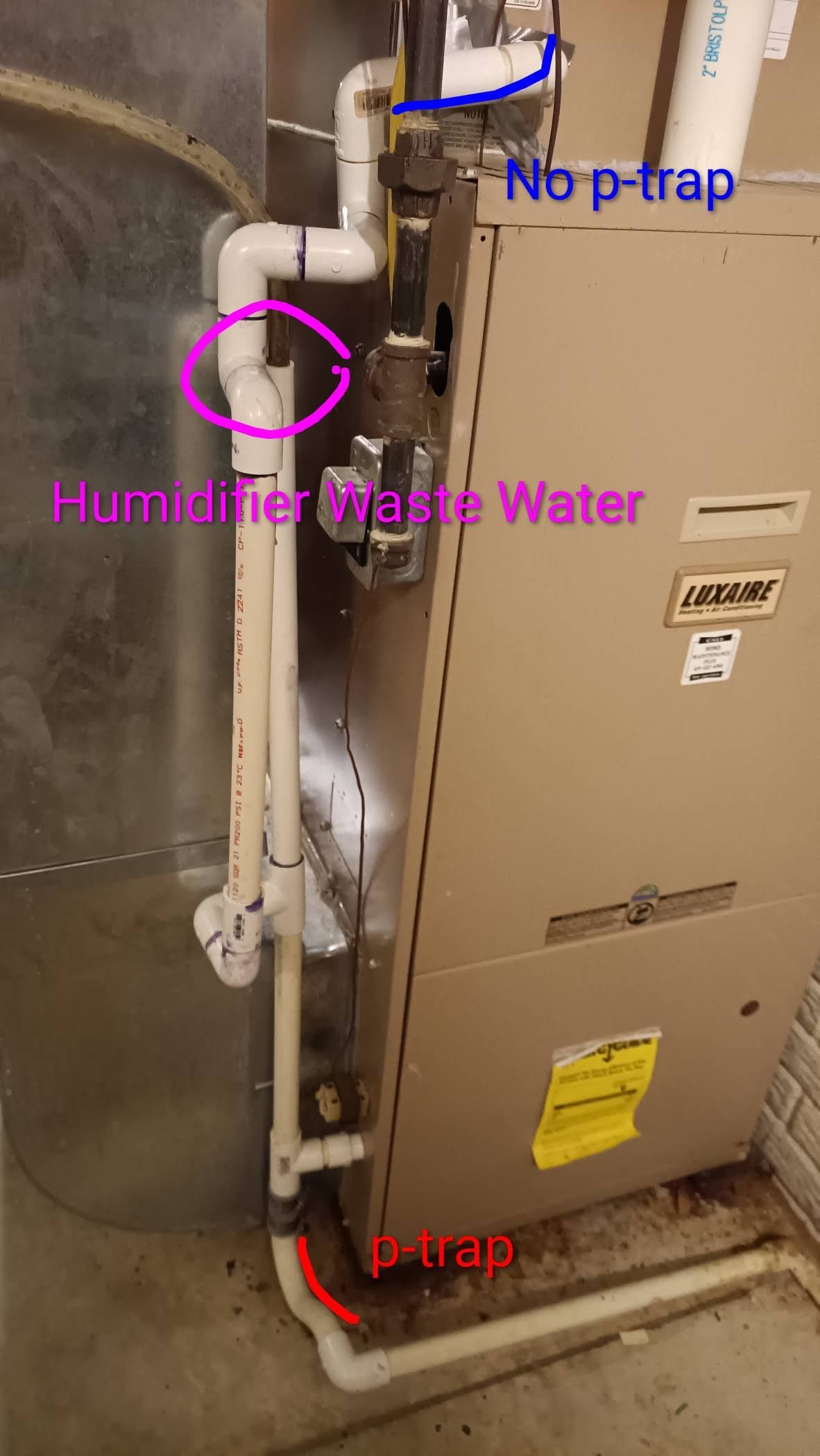
This combined line ran 20 feet across the basement floor and dumped directly into the sump pit. My hunch was that the open AC port was acting like an exhaust pipe, pushing "sump funk" into the system and pumping it two floors up to my desk. Additionally, since the furnace drain is technically part of the exhaust path, furnace exhaust was likely entering the house through this exact same pathway.
The Multi-Day Experiment: Isolation
I hold a PhD (though not in plumbing!). We are trained to make observations, formulate a hypothesis, and test it. I decided to test the "Sump Pit Hypothesis" by isolating the variables. I hacked the 21-year-old PVC line as shown below.
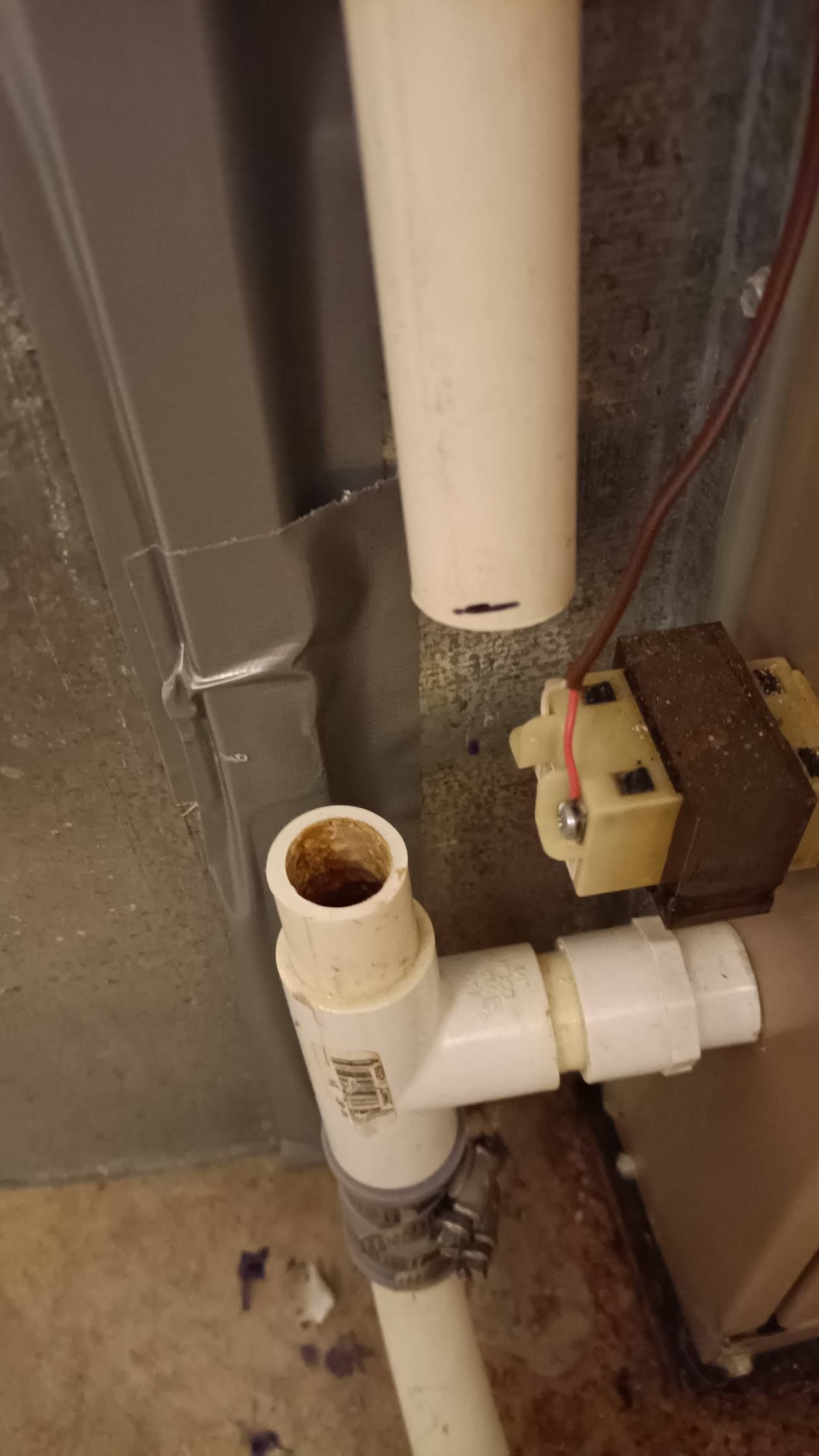
I immediately installed a manual ball valve without gluing it. For those unfamiliar with the hardware, a ball valve uses a simple internal sphere to completely shut off flow. I closed it, effectively cutting the physical connection between the AC drain opening and the pit. I waited. The true test wasn't that afternoon—it was the next morning. When 9:00 AM rolled around, the smell simply didn't come. This confirmed that the pipe was the bridge.
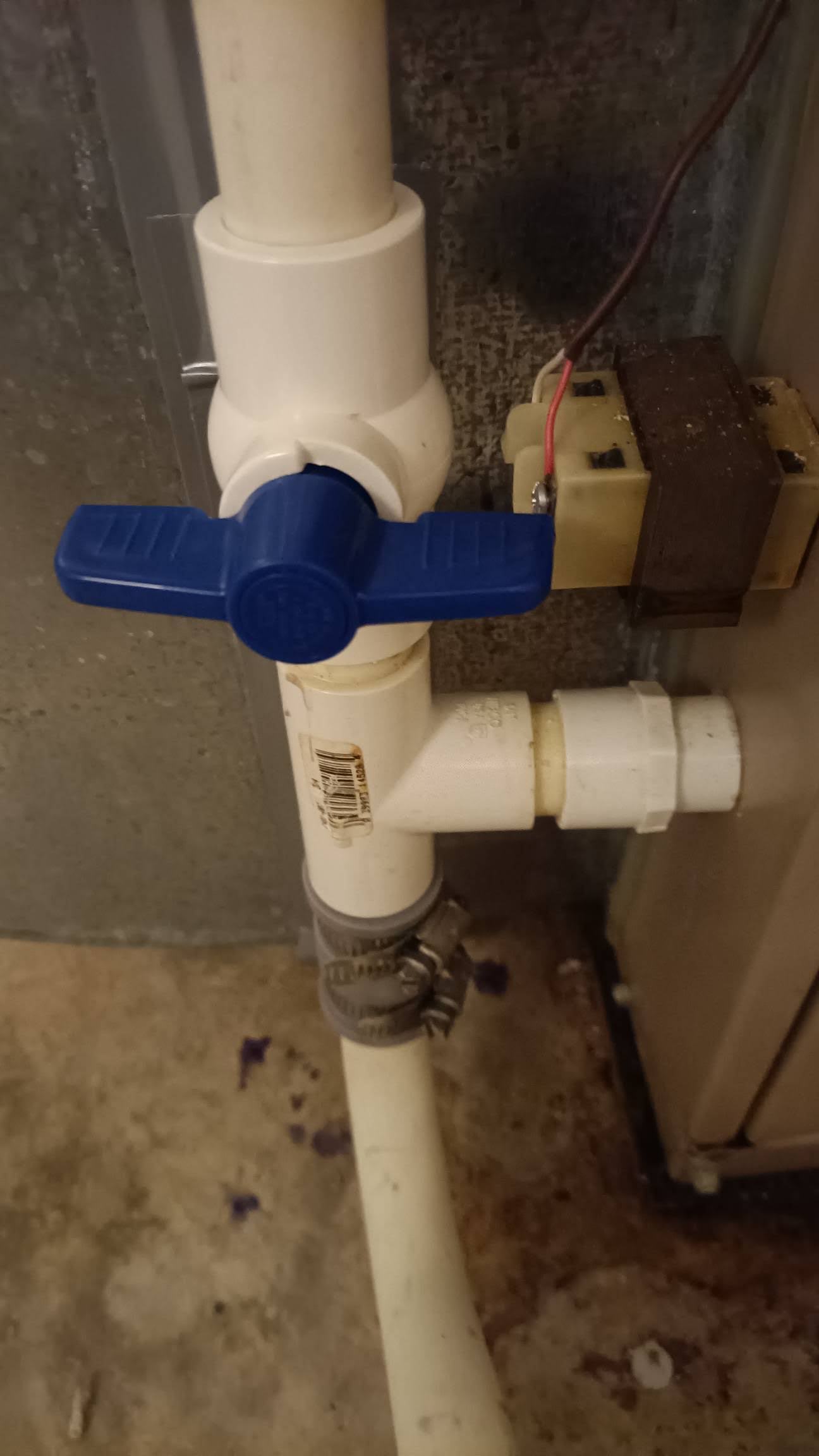
The basement smell also vanished. Looking at the first picture, the opening for the humidifier wastewater was a direct vent for sewer smells into the basement; the ball valve cut that off entirely.
The "PhD Redneck" Solution: The Check Valve and The Loop
A ball valve isn't a permanent solution. If I leave it closed in the summer, AC condensate will flood the furnace; if I leave it open, the "bridge" returns. I needed a permanent, automated way to drain water while keeping the "funk" out.
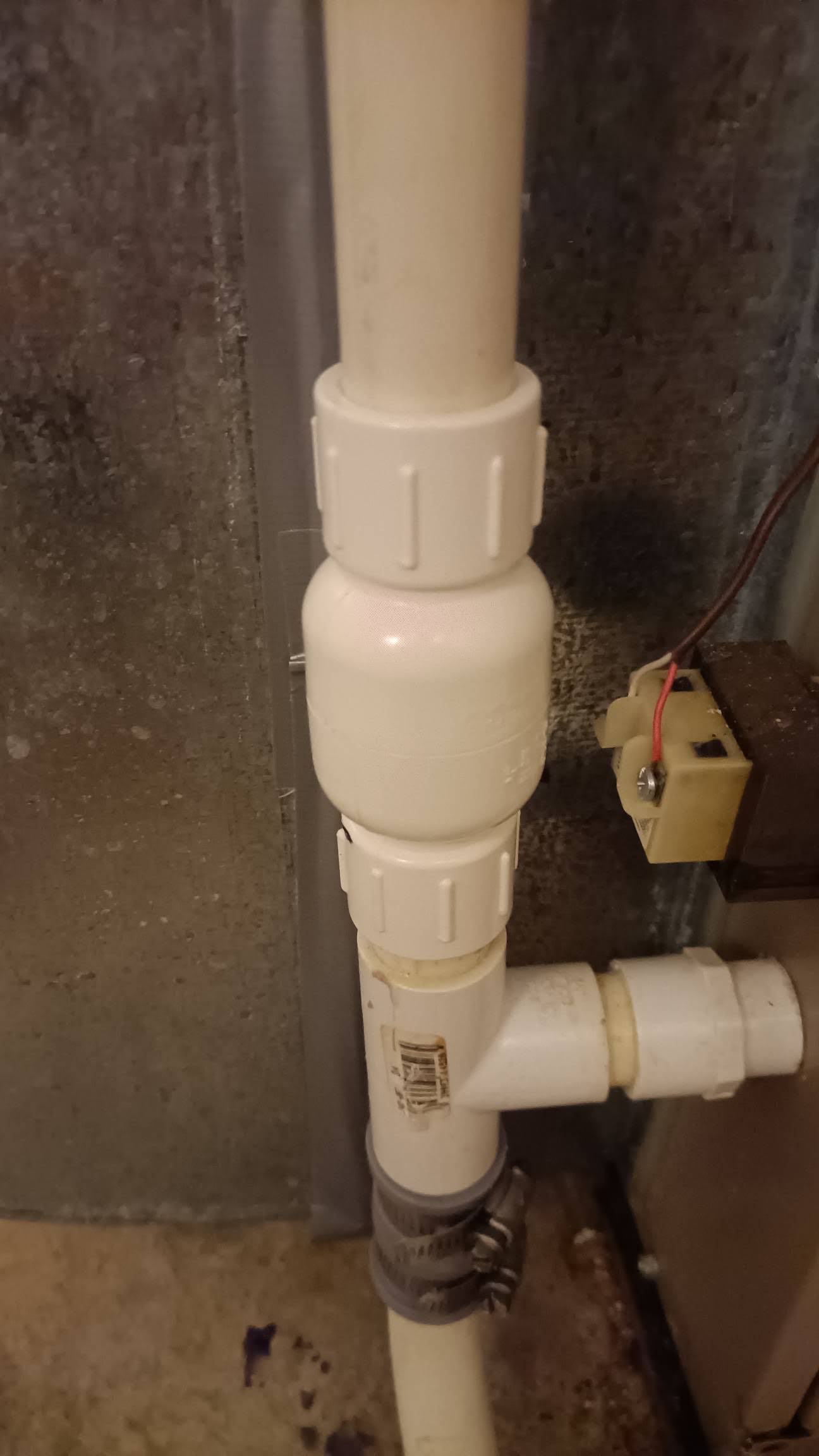
- The Check Valve: I replaced the ball valve with a weighted check valve. This is the logic hero of the system. It stays closed by default to seal out gases, but the weight of a water column forces it open to drain. It provides a 24/7 automated seal. I kept it unglued for easy maintenance. The specification here is critical: my lowest opening (the humidifier) is about 70 cm (27 inches) high. I chose a valve with a cracking pressure of 0.5 psi (14-inch water column), giving me nearly double the necessary head pressure. You can find the same check valve on Amazon here.
- The Clear Loop Trap: For the AC drain, I installed a 3/4" NPT to 1/2" barb adapter and created a loop of clear vinyl hose (1/2" ID, 3/4" OD). This acts as a new, independent seal for the AC line while the original furnace trap remains. The clear hose should save me a few pennies in summer as well. Originally, the drain hose vented out cold air for nothing.
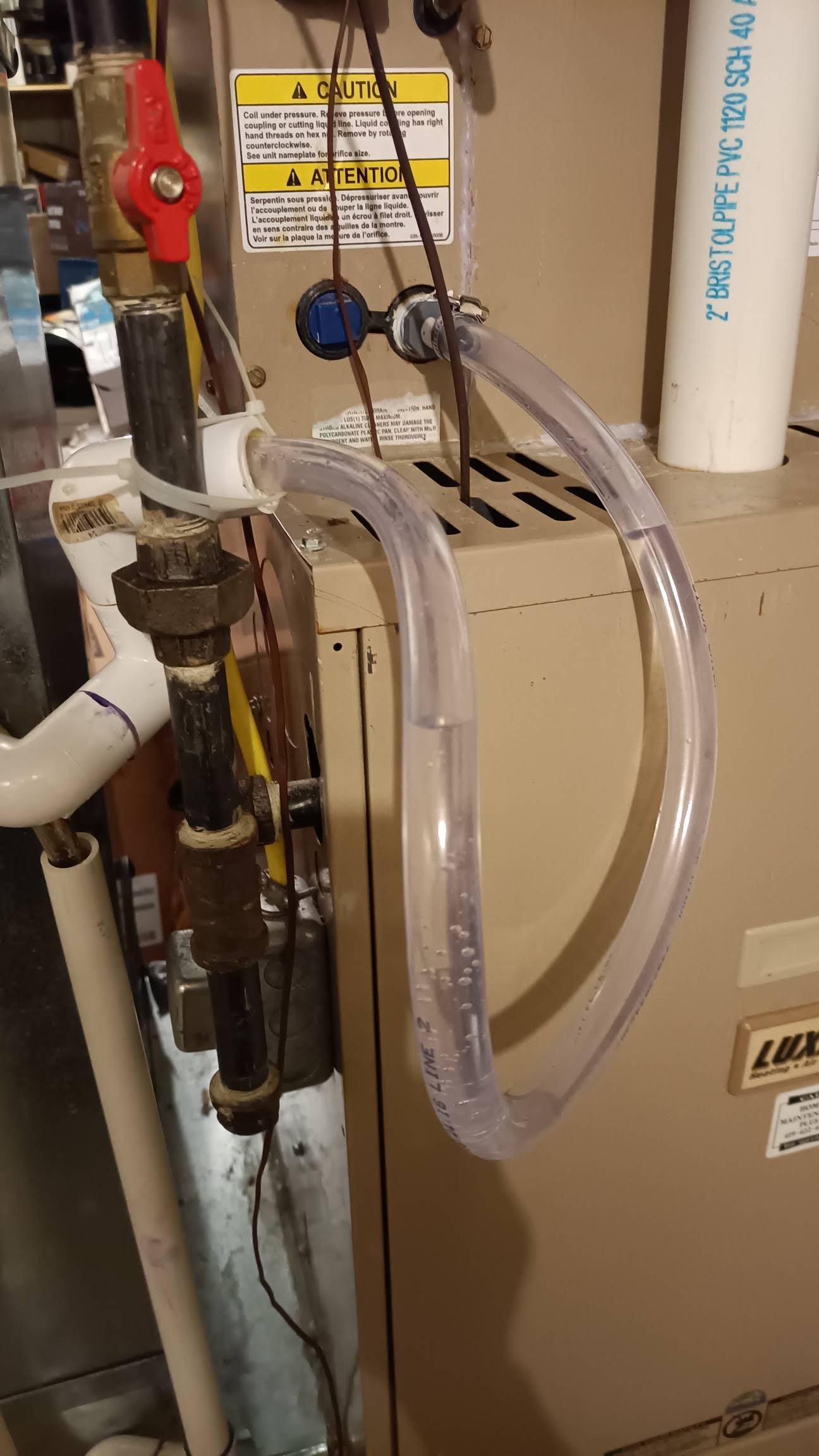
- The Manometer Effect: The clear tube allows me to observe the water seal. I noted a 5mm shift in water level when the blower starts—visual proof that the positive pressure is now contained. It is also easily removable for cleaning.
The "PhD Mind" Reveal: The Molecular Relay Theory
With the experiment a success, the biochemistry of the failure became clear:
- Overnight Saturation: The sump pit is full of gases like H2S (rotten egg) and NH3 (ammonia) because of microbe growth. While the furnace is off, gases from the sump dissolve into the stagnant water of the furnace trap.
- The Diffusion Bridge: Overnight, those molecules migrate through the water to the "house side" via simple diffusion.
- The Morning Stripping: When the furnace runs for the first few hours of the day, the positive pressure "strips" those gases out of the water and delivers them into the house, peaking around 9:00 AM. It only takes a trace amount of H2S for a sensitive nose to detect.
- Potential Direct Path: If the trap breaks because of inducer motor pressure or water within dries out, this becomes a direct path from the sump pit to living space.
- The Basement Smell: The same process occurred at the humidifier opening, but with a much shorter travel distance, leading to a more permanent basement odor.
Final Notes: Why Code Isn't Always Enough
- The Compliance Gap: As shocking as it sounds, the original setup may be code-compliant. Plumbing codes often don’t require traps for positive-pressure drains, meaning an un-trapped AC drain passes inspection even if it’s flawed.
- The Safety Oversight: Code compliance doesn't mean comfort or safety. Without a trap at the AC drain, furnace exhaust can be unintentionally pushed directly into your living space.
- The Summer Fail: In the summer, traps almost certainly dry out. Once that happens, sump pit smells migrate directly into your home. With the original setup, manually refilling those traps is nearly impossible.
- The Relay Theory: Even if a trap is filled with water, the "relay theory" we discussed proves that a simple trap won’t stop smells from reaching the upper floors of your home.
A fix like this is not just an upgrade; it is a necessity. Please feel free to use this HVAC solution in your own home. If you do, I only ask that you credit amzdealshq.com as the inventor of this idea with a link to this post.
To the Plumbing Code Committee: If you are listening, it is time to revise the code to prevent these issues. You are welcome to incorporate my fix into future revisions with proper attribution.
If you have a similar problem, definitely fix it. Figuring this out requires a PhD. Implementing the fix doesn’t.
Disclaimer and Release of Liability:
This "PhD Redneck Fix" describes a personal DIY solution for educational purposes only. Every HVAC and plumbing system is unique. I am not a licensed contractor or engineer. By using any information in this post, you do so entirely at your own risk. amzdealshq.com is not responsible for any property damages, personal injuries, death, or code violations. Always consult a licensed professional before modifying your home's mechanical systems.