The current consensus on the history of chess is taught as a settled fact: the game originated in India as early as the 6th century. According to this narrative, it was known as Chaturanga and was so popular that it was played at royal parties and military courts. It supposedly represented the four divisions of the Indian army and served as the direct ancestor to every version of chess played today. Except this entire timeline is likely wrong.
This post is not attempting to identify a different birthplace for chess or champion a new nationalist hypothesis. Its only purpose is to rebuff the current one. The evidence usually cited to support the Indian origin is not archaeological; it is academic hearsay that has been repeated for so long that it has been mistaken for the truth.
The Silence of a Master: Xuanzang’s Journey
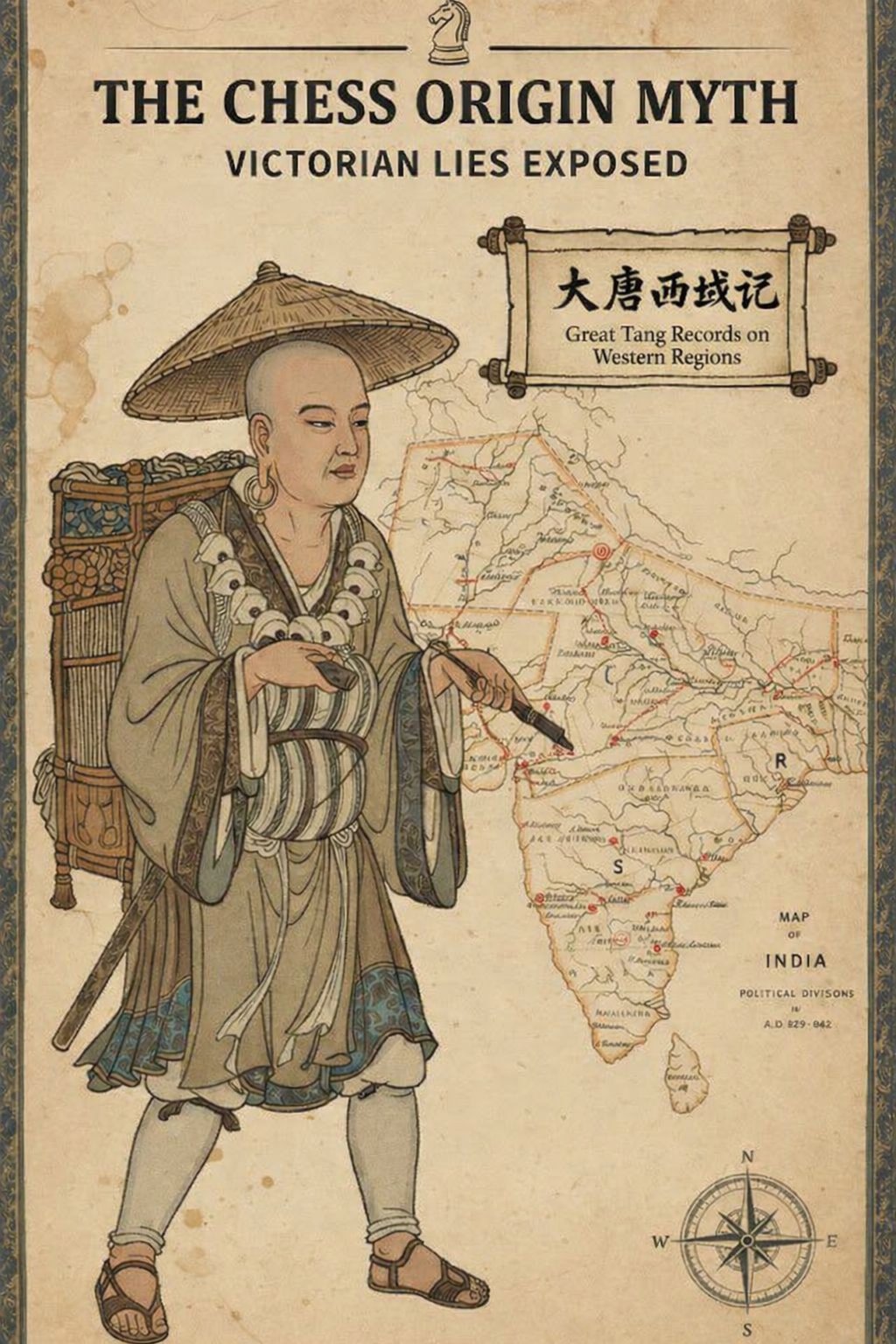
The most devastating blow to the Indian-origin theory comes from the Chinese monk Xuanzang. Between 629 and 645 AD, he conducted a sixteen-year pilgrimage across India. His mission was to bring the best of Indian culture, logic, and religion back to China. This journey was later immortalized in his monumental work, Great Tang Records on the Western Regions (Da Tang Xiyu Ji).
Xuanzang was an intellectual giant and a dedicated master of board games, specifically Go (Weiqi). In the Tang Dynasty, Go was a requirement for the scholarly elite. He was exactly the kind of person who would notice, play, and record a complex strategy game. His book is not just a religious diary; it is a comprehensive ethnographic encyclopedia of 7th-century India. Because India at the time did not keep detailed historical records, modern Indian history is actually built on Xuanzang’s writings.
- Archaeological Landmarks: Descriptions used by modern researchers to find Nalanda University and the Iron Pillar of Delhi.
- Flora and Fauna: Plants like the Amra (Mango), the Madhuka, and the Asoka tree, along with elephants, lions, and cattle.
- Social Customs: Local foods, textiles, kitchen layouts, and hygiene habits of different castes.
- Intellectual Life: Sanskrit logic traditions and university curricula.
Xuanzang lived in the heart of Indian royalty, spending years at the court of King Harsha. If chess were a popular royal game in the 7th century, it is impossible that he would have ignored it. He wanted to bring everything of value back to China, yet amidst his notes on every leaf, animal, and social ritual, he never mentioned a game with kings, elephants, and horsemen. His total silence is a loud contradiction to the idea that chess was a thriving Indian pastime during his stay.
The Victorian Invention: Forging History from Poetry
Why does the world believe a story that the primary witness of the era never saw? While the idea of an Indian origin had been proposed as a logical deduction by earlier scholars like Sir William Jones, it was Duncan Forbes in 1860 who weaponized these theories into what was presented as 'hard science'.
Forbes, a prominent scholar associated with King’s College, is the man responsible for the specific 5,000-year-old chess timeline. However, Forbes did not use archaeology; he used poetry. He and his peers turned to Persian literature, specifically the Shahnameh (The Book of Kings). This epic poem, written around 1000 AD, tells a legendary story of an Indian king sending a chessboard to a Persian king as a riddle. Forbes took this poetic legend, written 400 years after Xuanzang’s journey, and treated it as a literal historical transcript. He ignored the massive timeline gap and the fact that tales like the Legend of Sissa (the doubling of rice grains) were mathematical folk tales, not historical records.
During the British Raj, British scholars loved to glorify ancient India as an Aryan civilization that had fallen into decline. By framing India as the cradle of the world’s greatest game, they were constructing a history that suited the colonial lens — justifying British presence as the latest cycle of civilized rule.
This pattern of academic invention was common. A famous example is the Aryan Invasion Theory, where British historians used thin evidence to claim that all high culture in India was brought by northern invaders. Like the chess theory, it served a political purpose: it suggested that India had always been governed by outsiders, justifying the British presence as just the latest cycle of civilized rule. During situations like this, Forbes and his peers were willing to place narrative above rigor, to justify the brutal British occupation of India, and to serve the interests of the British Empire. Forbes essentially took a loosely theorized origin and forged a rigid, fraudulent history out of medieval Persian verses.
Conclusion
Why did these scholars lie? Because a 5,000-year-old royal history sounds better than the likely truth: chess evolved gradually along the Silk Road through a mixture of Chinese, Indian and Persian influences. If the most meticulous observer of the 7th century — a man who loved board games and recorded everything from mangoes to laws to royal parties — saw no chess, then the current history may be a house of cards built on Victorian hearsay. If chess indeed originated from India, it must happen at a later time.
I did not discover these inconsistencies myself. I once read a convincing article on this topic but lost the source. Because the argument was so striking, I wrote this summary from memory. This is not a scholarly article and does not follow academic citation standards — it is simply a reflection on a historical debate that deserves more attention.